
Dual Class Capital Structures And Share Transfer Rules
Dual class structures separate voting control from economic equity, using charter transfer rules and automatic conversions to protect management authority.

Wedge

Separation of Governance and Economic Return
Corporate charters split share capital into distinct tiers to sever the direct link between equity investment and corporate authority. A standard dual class architecture allocates high-vote shares, often designated as Class B equity carrying ten votes per unit, to company organizers, while issuing single-vote Class A units to outside capital providers. Control operates through votes.
Cash flows follow economic units. When an enterprise issues two distinct classes of equity, the ledger records an immediate divergence between the financial exposure borne by passive investors and the directional authority exercised by the holders of the superior voting units. The financial claim entitles the holder to dividends and liquidation distributions on a pro-rata basis, yet the voting instrument dictates board appointments, merger authorizations, charter amendments, and asset liquidations.
Charter provisions fix this mathematical division at the time of incorporation or during pre-public recapitalizations. A founder holding fifteen percent of the total outstanding equity can wield over sixty percent of the aggregate voting power, provided the high-vote units carry a ten-to-one or twenty-to-one advantage over the publicly held instruments. The operator seat commands operational decisions because the underlying voting block defeats any shareholder resolution brought by external financiers.
Capital providers accept this discount in governance influence to obtain access to the commercial upside generated by the management team. The arrangement functions smoothly while cash generation matches projections, but tensions surface as soon as reinvestment strategies diverge from market expectations.
A voting-to-cash-flow wedge insulates corporate management from outside shareholder intervention only while high-vote equity remains concentrated in operational hands.
Public equity markets apply an observable pricing penalty to dual class issuers that fail to demonstrate consistent growth, discounting the equity value relative to single-class counterparts in the same operating sector. This governance discount reflects agency costs inherent in structures where those who make strategic determinations bear only a fractional consequence of financial losses. When capital allocators cannot remove ineffective management through proxy contests or hostile takeovers, the pricing mechanism of the secondary exchange becomes the sole outlet for investor dissatisfaction.
The price drops while the voting block remains undisturbed.

Mechanics of Disproportionate Voting
The mathematical leverage within multi-tier equity rests upon the precise ratio established inside the certificate of incorporation. Common arrangements employ a ten-to-one voting ratio, though private enterprises occasionally implement structures granting fifty votes per unit or absolute consent rights over enumerated executive actions regardless of share percentage. The governance apparatus operates through distinct operational levers:
- Disproportionate voting ratios allocate unequal numbers of ballots per share, concentrating board election authority into a minority holding of the total issued capitalization.
- Class-specific director seats guarantee that designated common stock series elect a majority of the board of directors irrespective of aggregate voting tallies at annual meetings.
- Charter amendment vetos prevent external investors from altering transfer restrictions, conversion schedules, or class privileges without separate class authorization votes.
- Dividend parity requirements mandate identical per-share economic distributions across all share tiers to preserve tax treatment and satisfy public exchange listing standards.
The company retains the asset. Outside shareholders purchase cash flow rights while organizers retain corporate sovereignty. This structure alters the fiduciary environment because directors elected solely by high-vote shares owe statutory duties to the enterprise as a whole, yet their appointment remains beholden to a single individual or a compact executive coalition.
When the holders of high-vote equity stop providing active operational labour, the divergence between paper authority and daily commercial execution widens into administrative paralysis.
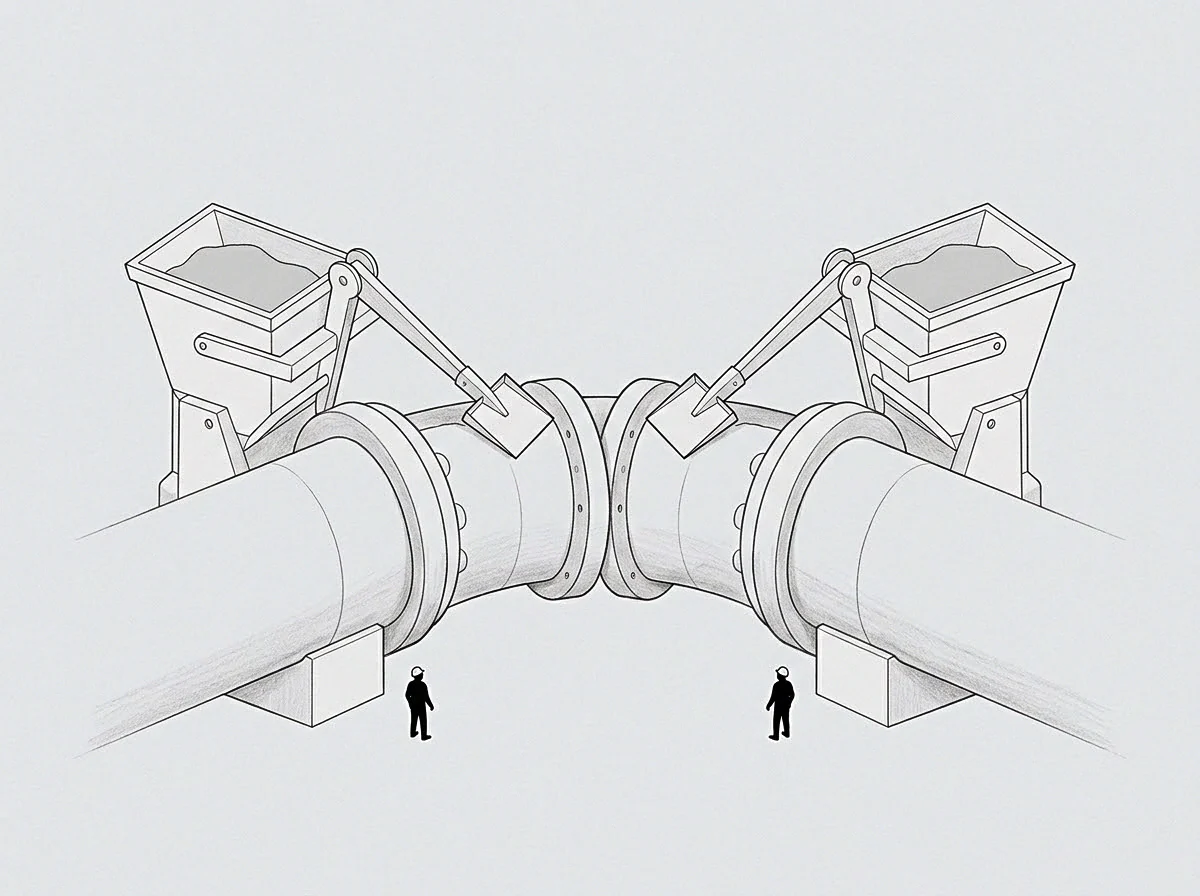
Wall

Statutory Transfer Restrictions and Charter Limits
Legal instruments prevent the dispersal of high-vote equity into hands outside the initial executive circle. The corporate bylaws and shareholder agreements construct boundaries around share transfers, forbidding sales, assignments, pledges, or gifts without prior written consent from the board or compliance with strict transfer protocols. The transfer book closes.
State corporate statutes permit corporations to impose reasonable restrictions on the alienation of securities to preserve operational stability, maintain regulatory exemptions, or retain tax classifications. The central instrument defending a dual class architecture is the mandatory transfer restriction, which dictates that any transfer of high-vote paper to an unapproved party strips the equity of its super-voting status.
The restriction appears directly upon the share certificate face or within the electronic book-entry notices delivered to registered owners. Unrestricted transfers would allow third-party purchasers to accumulate high-vote blocks on secondary private markets, creating shadow voting coalitions capable of destabilizing executive control. The restrictions operate through a sequence of protective gates.
Rights of first refusal require departing executives to offer their equity to the company first, then to remaining founders, at either a matched bona fide offer price or an independent appraisal figure. Pledges of high-vote equity as loan collateral face complete prohibitions under well-drafted shareholder pacts, preventing commercial lenders from seizing governance power following personal debt defaults.
A right of first refusal converts uncoordinated private stock sales into mandatory enterprise acquisitions or organized internal redistributions.
Exemptions exist solely for permitted transferees, defined narrowly to include revocable living trusts for estate planning, wholly owned holding entities, or immediate family members, provided the original holder retains exclusive voting proxy over the transferred shares. If the proxy separates from the beneficial interest, the protective wall activates. The registry records legal title.
When an unauthorized transfer attempt occurs, the corporation refuses registration on the transfer ledger, rendering the transaction void ab initio under governing corporate statutes.

Transfer Mechanisms Across Corporate Stages
The legal barriers governing equity movement shift across enterprise development stages, evolving from contractual investor covenants into rigid public market charter mechanisms.
| Mechanism Type | Document Location | Trigger Event | Voting Impact | Enforcement Remedy |
|---|---|---|---|---|
| Right of First Refusal | Shareholder Agreement | Receipt of third-party purchase offer | Preserves existing voting proportion if exercised | Corporate buyback or redistribution among owners |
| Automatic Conversion | Certificate of Incorporation | Unapproved transfer or owner death | Collapses high-vote shares into single-vote common | Cancellation of super-voting certificate on registry |
| Permitted Transfer Rule | Investor Rights Agreement | Estate planning transfer to family trust | Maintains super-voting power under founder proxy | Void transfer if voting authority leaves founder |
| Drag-Along Covenant | Voting Agreement | Approved sale of company by majority | Forces minority holders to vote for transaction | Specific performance through appointed attorney-in-fact |
| Lock-Up Covenant | Underwriting Agreement | Initial public offering listing date | Freezes all transfers for fixed calendar period | Stop-transfer orders placed with transfer agent |
Contractual lock-up clauses restrict insider equity liquidity following public listings, typically prohibiting transactions for one hundred eighty days. Transfer restrictions in private venture rounds rely on contractual remedies between signatories, whereas charter-based restrictions bind all current and future holders by operation of law. A breach of a shareholder agreement triggers damages or injunctive relief, but a violation of a charter restriction invalidates the transaction entirely.
The transfer agent executes a stop order on the corporate books immediately upon notification of any non-compliant assignment. The buyer receives zero votes. Legal title to the superior voting rights cannot pass across the statutory perimeter established by the charter, leaving an unauthorized acquirer holding low-vote paper or facing an outright invalidated acquisition.
The specific clause governing affiliate assignments dictates that any transfer to an entity wherein the transferor holds less than one hundred percent voting authority triggers the immediate reclassification of those shares into ordinary common stock.

Friction

Operational Separation and Disengagement
Governance discord escalates when an individual who stepped away from operational duties retains superior voting shares. The operator seat requires constant attention to commercial deliverables, personnel management, vendor arrangements, and capital expenditure decisions. The owner seat, insulated by high-vote paper, can sit empty for months, intervening only to block strategic transactions, debt refinancings, or equity incentives for active operators.
Sweat equity spent in early operational phases creates paper ownership that persists indefinitely, generating substantial organizational drag when the commercial direction demands structural adaptation. Disputes freeze capital allocation.
Take two partners who incorporate an enterprise on equal terms, establishing an operating agreement that issues high-vote units to both individuals to preserve long-term management independence. Assume the technical partner leaves active employment after twenty-four months to pursue independent commercial activities, retaining fifty percent of the voting equity, while the operating partner remains in the business sixty hours a week for another four years. When the enterprise requires a mezzanine financing facility or creates an employee stock option pool, the departed partner holds negative control over the enterprise.
The active operator creates current economic value, yet the absentee partner commands the governance gates. The active manager cannot hire high-level executives because option grants dilute the equity pool while the inactive partner vetoes compensatory equity expansions.
Departed operators who retain super-voting equity possess the structural power to halt corporate growth without bearing daily operational accountability.
The asymmetry between daily labour and paper authority breeds acute interpersonal and governance conflict. Active managers argue that ongoing commercial survival depends on rapid decision-making and operational flexibility. Inactive high-vote holders prioritize absolute asset preservation, dividend extractions, or unrealistic valuation multiples for buyout discussions.
Unanimous consent rarely arrives. The enterprise finds itself caught between an operational core that lacks formal control and a formal control group that lacks operational engagement.

Can Super Voting Rights Survive Private Transfers?
Legal challenges to dual class voting structures emerge when controlling shareholders attempt to transfer high-vote blocks through indirect financial transactions or testamentary devices. Surviving spouses, estate executors, or private equity recapitalizers frequently assert that beneficial ownership transfers preserve superior voting privileges as long as the underlying certificates remain intact. Chancery courts evaluate these disputes through strict statutory construction of the corporate charter.
When certificate language states that superior voting rights attach to the holder rather than the share itself, any legal transfer of the physical or book-entry share strips the voting advantage instantly.
Indirect transfers through holding companies create contested ground. A founder places high-vote shares inside a limited liability company, then sells ninety percent of the membership interests in that holding company to an external buyer while retaining nominal managerial authority. Minority common shareholders initiate litigation, asserting that the change in beneficial economic interest violates the charter transfer provisions.
Evidence from corporate litigation shows that courts look past intermediary entity labels to assess whether effective economic control and governance authority transferred to an unauthorized party. If the economic realization shifts away from the organizer, the court enforces reclassification into single-vote common equity.
Control without operational involvement resembles a tax on ongoing enterprise labour. The founder holds the paper, but the company must generate enough excess margin to satisfy passive ownership while compensating replacement management.
The active management team consistently states that voting weight must follow current operational exposure or the business will fail to attract institutional leadership.

Conversion

Sunset Provisions and Structural Dissolution
Contractual expiration mechanics resolve the permanence of multi-tier capital arrangements by automatically extinguishing superior voting privileges upon specified baseline milestones. These sunset provisions function as automatic conversion valves built directly into the certificate of incorporation. When a sunset fires, each high-vote share converts into exactly one share of ordinary common stock on a one-to-one basis without requiring shareholder approval, board consent, or additional cash consideration.
The conversion occurs by operation of corporate law across three standard structural models:
- Time-based sunsets establish an absolute calendar deadline, terminating superior voting rights between seven and fifteen years following the enterprise formation or public listing event.
- Ownership-based sunsets trigger immediate conversion when the aggregate economic ownership held by initial founders drops below a defined threshold, commonly ten to twenty percent of total outstanding shares.
- Event-based sunsets activate upon the death, permanent mental disability, or voluntary employment termination of the designated high-vote holder, ensuring governance power does not transfer to non-operator heirs.
Ten votes become one. The automatic conversion eliminates the voting-to-cash-flow wedge, reunifying governance authority with economic ownership across a single common share class. Modern institutional asset managers advocate for mandatory time-based sunsets, asserting that managerial insulation benefits early product development but harms operational efficiency as companies mature into capital-intensive enterprises.
Founders oppose mandatory sunsets, arguing that long-term strategic investments require multi-decade protection from quarterly market pressures.
An automatic conversion sunset terminates the governance premium the instant an organizer ceases to occupy an executive seat within the enterprise.
Sunsets alter the economic calculations surrounding corporate sales. If an enterprise approaches an ownership threshold sunset, the founder faces an impending loss of voting control, creating an incentive to negotiate a corporate sale or consolidation before the super-voting leverage expires. Once converted, the founder becomes an ordinary minority shareholder subject to standard majority governance rules, vulnerable to board removals, asset sales, and hostile takeovers.

Unwinding Multi Tier Ownership
The voluntary unwinding of a dual class structure demands precise recapitalization agreements to avoid litigation from disadvantaged common equity holders. Reclassification transactions offer cash premiums or additional common shares to high-vote owners in exchange for relinquishing their superior voting rights. A recapitalization plan that awards high-vote owners extra economic shares dilutes the remaining equity holders, inviting breach of fiduciary duty lawsuits from institutional investors who claim the board paid an unauthorized toll to re-establish democratic governance.
Governance defines the exit.
Special independent board committees must evaluate any recapitalization that pays a control premium to dual class insiders. The legal defensibility of the transaction rests upon whether the business conditioned the reclassification on both independent board approval and the uncoerced vote of a majority of the minority common shareholders. When an enterprise fails to secure an unconflicted approval procedure, courts apply entire fairness review, placing the evidentiary burden on controlling insiders to prove that both the process and the financial terms were fair to non-voting capital.
If the transaction passes review, the charter amendment files with the secretary of state, cancelling the high-vote series entirely.
The residual question remains whether future statutory corporate reforms will eliminate perpetual dual class mechanisms entirely, or whether private capital will continue migrating toward bespoke contractual jurisdictions to insulate corporate command indefinitely.