
Codifying Founder Tacit Knowledge Before Executive Transition in Closely Held Businesses
Codifying tacit knowledge before executive transition requires structured shadowing and incident debriefs to extract unwritten decision heuristics.

Paper
Standard operating manuals document administrative routines while leaving out the mental frameworks that steer executive choices. In closely held enterprises, continuity depends on informal knowledge built through decades of hands-on management: personal mental models, diagnostic instincts, and unwritten understandings with stakeholders that never enter corporate documentation.
What documentation can actually transfer depends on the boundary between explicit procedures and tacit habits. Explicit knowledge, structured facts, code, and repeatable steps, survives written codification. Tacit knowledge involves real-time pattern recognition, situational assessment, and contextual observation developed through long exposure to operational anomalies.
When an outgoing executive attempts to compress decades of operating habits into standard written records, the critical decision rules governing capital deployment, customer pricing variances, and key employee retention remain unwritten.
Explicit documentation captures formal routines while cognitive mental models remain tied to operational experience.
Translating implicit operating habits into written text usually yields static summaries that successors struggle to put to work. The codification effort fails because outgoing leaders rely on compiled heuristics, sizing up operational risk without consciously parsing each underlying variable. Without an active observation protocol, these recording efforts produce abstract overviews that offer little practical direction during non-routine disruptions.
Failing to draw out deep operational context before a departure leaves incoming leadership to rely on trial and error through initial crises. An explicit knowledge audit clause attached to the purchase agreement fixes the handover scope, converting unstated operational practices into observable demonstration cycles.

Engine
Translating executive mental models into transferable assets requires mapping cognitive heuristics across primary operating domains. The diagnostic routines used to evaluate key supplier stability, customer contract profitability, and regulatory compliance rely on implicit thresholds built from historical failures.
In closely held firms, the owner operator functions as the central risk regulator, absorbing organizational variance through direct, uncodified personal interventions. When this central regulatory capacity leaves the firm without structural extraction, the enterprise experiences operational volatility across core functions. Capturing these implicit diagnostic frameworks involves isolating specific domain triggers and pairing them with structured scaffolding techniques.
| Domain | Implicit Tacit Model | Explicit Scaffolding Method | Transfer Fidelity Risk |
|---|---|---|---|
| Vendor Negotiation | Unstated allowance thresholds based on historical counterparty reliability | Paired negotiation debriefs mapping concession boundaries | Loss of non-verbal leverage cues during counterparty dispute |
| Capital Allocation | Intuitive ROI thresholds adjusted for unquantified market exposure | Decision tree documentation paired with historical scenario walk-throughs | Over-investment in marginal accounts due to missing context |
| Key Talent Retention | Informal psychological contracts and unwritten performance concessions | Structured stakeholder mapping paired with explicit compensation bounds | Key personnel departure following unexpected boundary enforcement |
| Crisis Management | Rapid pattern recognition grounded in previous operational shutdowns | Critical incident debriefing protocol capturing exception rules | Delayed organizational response during novel supply chain friction |
Mapping these implicit models requires distinguishing between surface routines and deep cognitive structures. Surface routines cover recurring administrative tasks, financial reporting sequences, and scheduled organizational meetings. Deeper cognitive structures govern exception handling, capital protection rules, and informal power dynamics within the firm.
When codification efforts focus exclusively on surface administrative mechanics, the primary driver of firm performance remains trapped within the outgoing executive’s personal habits.
Without explicit diagnostic thresholds, incoming executives often misread routine vendor volatility, causing capital misallocation across early operating quarters.

Clock
Structured knowledge transfer operates within a defined temporal sequence, shifting systematically from passive observation to independent execution under mentorship. Transition timelines in closely held businesses often collapse due to departure fatigue or financial transaction milestones, truncating the observation window required to surface implicit operating wisdom.
Transfer fidelity relies on the phased removal of structural support, aligning with the zone of proximal development. In early transition phases, the incoming leader observes the outgoing executive during live operational challenges, capturing unwritten diagnostic cues. As the transfer progresses, the role structure reverses, placing the successor in active command while the predecessor provides real-time coaching and post-execution debriefs.
- Shadowing active customer renegotiations exposes underlying pricing tolerances before administrative handoff occurs.
- Paired execution of quarterly financial reviews forces the explicit articulation of unstated balance sheet risk limits.
- Supervised independent operation transfers complete authority over daily operations while maintaining a structured debriefing cadence.
- Scaffold removal completes the transition, leaving the successor with full operational command and verified diagnostic heuristics.
Transfer fidelity drops when observation precedes structural role clarity.
Moving through this sequence without rigid adherence to phase gates risks premature scaffold removal. When the outgoing executive departs before the successor demonstrates mastery over unwritten exception rules, organizational performance degrades rapidly under market stress.
A debriefing session scheduled immediately following a high-stakes meeting captures context that routine weekly reviews miss.

Grip
The cognitive load placed on incoming leadership during executive transitions dictates how effectively implicit mental models move between individuals. Extracting tacit knowledge during live operations requires deliberate debriefing frameworks built around real-time critical incidents.
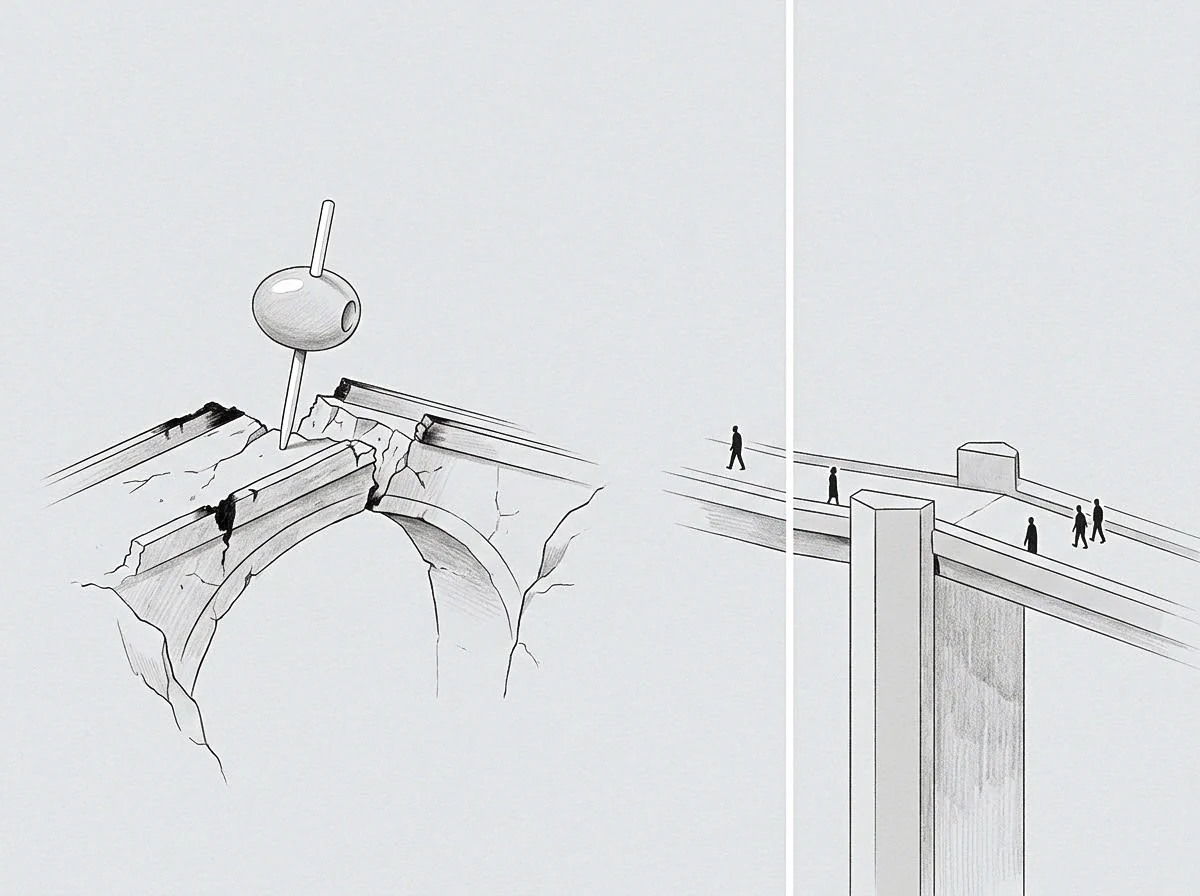
Can shadow debriefs capture unstated decision boundaries?
Shadow debriefing functions by dissecting recent critical incidents to expose the underlying rationale behind executive choices. Rather than asking broad questions regarding management philosophy, the successor prompts the outgoing leader to walk through specific operational crises, isolating exact information inputs, perceived risks, and rejected alternatives. This method bypasses rationalized post-hoc justifications, surfacing the actual heuristics deployed during high-stress operational moments.
Consider an industrial distribution firm generating fifteen million dollars in annual revenue where the departing owner operator holds thirty years of specialized supplier relationships. The assumption rests on two conditions: the outgoing leader agrees to a six-month structured transition, and the incoming chief executive possesses foundational industry competence. During a major supply chain bottleneck, the outgoing leader executes a rapid inventory re-allocation without consulting written inventory formulas.
A structured shadow debrief conducted within four hours reveals that the decision relied on unstated supplier credit limits and informal freight prioritization agreements forged decades prior.
Without structured critical incident debriefs, these informal operational mechanisms remain invisible to incoming leadership until a system failure occurs. Capturing these unstated operational dependencies requires formalizing the debriefing cadence across specific operational triggers.
- Incident Trigger Isolation identifies operational anomalies that require immediate executive intervention rather than standard procedure.
- Alternative Rejection Mapping documents the specific operational options considered and dismissed during crisis resolution.
- Counterparty Assumption Audit uncovers unwritten agreements and informal expectations existing between executive leadership and external stakeholders.
- Heuristic Rule Articulation translates intuitive diagnostic choices into explicit operating boundaries for incoming management.
Without observing three consecutive supplier negotiation cycles firsthand, vendor allowances disappear before the second quarter.

Net
Residual knowledge that evades codification represents a persistent risk during executive transitions in closely held businesses. Even where equity retention alters departure incentives, certain elements of personal observation, relational intuition, and deep historical context cannot move through written artifacts or observation cycles alone.
To mitigate the risks associated with uncodified operational residue, closely held firms must utilize governance and contractual structures designed to retain access to diagnostic observation without stalling command authority. Special advisory arrangements, retention holdbacks tied to operational continuity metrics, and structured equity clawbacks preserve outgoing executive availability during unexpected operational crises. These legal and financial safeguards act as risk containment nets, absorbing operational shock while the incoming executive builds independent firm-specific tacit knowledge.
Operational continuity depends on structural risk containment when personal observation remains uncodified.
Structural risk containment mechanisms align the incentives of outgoing founders with long-term enterprise stability. By linking financial payouts or consulting retainers to explicit knowledge transfer milestones and operational stability metrics, the enterprise reduces the probability of abrupt knowledge flight. The objective centers on creating a controlled off-boarding environment where residual expertise remains accessible during non-routine disruptions without undermining the authority of new leadership.
It remains uncertain whether advisory arrangements preserve access to deep diagnostic observation or merely delay the necessary confrontation with unmapped operational decisions.