
Maintaining operational continuity when transferring founder dependent client relationships in small firms
Transferring founder-dependent client relationships requires phased authority migration, explicit tacit knowledge codification, and strict boundary enforcement.

Anchor
An email arrives at eleven on a Sunday night asking for a strategic opinion never written into a contract. The client addresses the message privately. This interaction reveals the informal structure supporting account retention in small professional firms.
Revenue in boutique agencies and advisory practices frequently rests on personal trust built through years of direct problem-solving by the firm founder. When account ownership centers on individual accessibility, client loyalty attaches to a person rather than an enterprise.
The primary owner functions as an operational risk absorber, taking direct responsibility for service quality, technical execution, and commercial flexibility. In a practice of fifteen employees where four key client accounts produce sixty percent of annual recurring revenue, the owner manages all executive interactions across those accounts, handling strategic scoping, fee adjustments, and quarterly reviews. Operational team members execute tasks in the background, communicating through internal channels or standard ticketing systems.
When the firm attempts to transfer account management to an operational lead, the client interprets the shift as a service downgrade.

Implicit Commitments in Relational Account Management
Migrating a client relationship involves moving social capital, informal promises, and communication cadences that exist outside standard operating documentation. Clients develop baseline expectations regarding response speed, decision authority, and commercial leeway. An operational successor entering the relationship lacks the implicit authority to grant immediate contract adjustments or credit terms.
The client recognizes this gap immediately and pushes back against the transition.
The transfer process fails when an organization treats account migration purely as an administrative reassignment. Clients notice when strategic judgment yields to procedural escalation. If the successor must seek internal permission before answering executive questions, client confidence erodes rapidly.
The client begins looking for alternative providers who offer direct access to decision-makers.
The Friction of Relational Transfer
Successors face systemic disadvantages when taking over founder-dependent relationships. They inherit historical commitments that were never logged in project management tools, including unbilled advisory hours and custom deliverables. Without visibility into these covert agreements, the successor attempts to enforce standard operational boundaries, creating immediate friction with the client.
The client interprets rigid boundary enforcement as a breakdown in service quality. Resolving this tension demands an explicit discovery process where the outgoing lead surfaces every informal agreement before authority transfers. Unspoken expectations must enter formal documentation, or the firm must renegotiate them directly with the client before the exit occurs.
“The firm executed deliverables effectively, but strategic counsel rested with the firm creator, and operating without direct access alters the commercial value proposition.”

Sequence
Migrating high-value client relationships out of one person’s hands demands a structured operational progression over several months. Sudden handoffs break trust, while indefinite handovers anchor the original lead to the account indefinitely. A structured progression creates predictable operational milestones for both the successor and the client.

Shadowing Operational Mechanics
The initial phase of transfer places the successor inside client communication channels without altering public account authority. During this phase, the original lead remains the primary voice in meetings, while the successor observes relational nuances, informal preferences, and underlying business constraints. The successor documents unwritten operational rules, including how the client prefers risk communicated, which internal stakeholders hold veto power, and what reporting formats yield fast approvals.
Co-working on live client issues builds successor credibility faster than formal introductions. In meetings, the original lead deliberately routes technical and operational questions to the successor. This shift signals technical competence while preserving the security of the established relationship.
Account handovers succeed when operational authority moves before commercial visibility changes.

Staged Authority Migration
Authority transfers through incremental operational handoffs. The original lead steps back from daily task coordination, redirecting client inquiries to the successor while remaining visible during monthly or quarterly strategic reviews. This progression moves through clear phases, each carries specific stakes for firm retention.
- Shadowing and Mapping involves documenting unspoken communication expectations and mapping client decision structures over thirty days, preventing operational missteps during initial client contact.
- Joint Client Co-Delivery establishes thirty days of shared meeting leadership, where the successor handles operational updates while the original lead retains strategic direction, establishing technical authority without triggering client insecurity.
- Primary Operational Switchover reassigns direct client inquiries to the successor for sixty days while maintaining passive executive oversight, forcing internal team alignment behind the new lead.
- Commercial Lead Transition hands over contract renewals and scope discussions to the successor during scheduled planning cycles, testing whether commercial trust has transferred completely.
- Scaffold Decommissioning ends routine participation by the original relationship owner, leaving clear escalation boundaries that protect the successor’s seat.

Managing Escalation Pathways
A critical failure occurs when clients bypass the designated successor to contact the original lead directly during routine challenges. Operational continuity demands strict adherence to escalation boundaries. When a client reaches out to the original owner, the owner routes the request back through the successor, reinforcing the successor’s position as the primary authority.
Clients test new account leads within thirty days of transition. If the original lead breaks protocol and resolves issues directly, the transfer timeline resets entirely, leaving the firm exposed to account churn once the founder leaves the firm.
Handing over an account while retaining back-channel executive access preserves client retention while building successor autonomy.

Shelf
Codification transforms tacit knowledge into explicit operational documentation that surviving team members can execute. CRM systems record basic transactional data, contracts, and communication histories. However, account relationships carry significant tacit residue that resists simple documentation, including executive communication tone, risk tolerance, and unstated corporate political dynamics.

Explicit Records and Tacit Knowledge Bounds
Standard operating procedures capture explicit workflows, billing histories, and deliverable specifications. These elements fit neatly into internal knowledge repositories. However, tacit knowledge stays in practice.
A client Chief Executive might dislike bulleted updates, or an account director might prioritize speed over formatting perfection. These details dictate whether an account thrives under new management.
Tacit account knowledge transfers through direct co-working, provided the successor controls client communications during critical operational reviews.
Tacit knowledge cannot be fully written down in a standard manual. It demonstrates itself in context. The successor absorbs communication tone, negotiation posture, and boundary management by participating in live client friction points alongside the outgoing lead.
Knowledge written down is only half the seat.

Scaffold Removal Protocol
Scaffolding represents the temporary operational support provided to the successor during the account transition. This support includes co-attending client calls, reviewing strategic deliverables before presentation, and vetting written communications. Removing operational scaffolding too early leaves the successor vulnerable to client pushback during contentious negotiations.
Removing scaffolding too late signals to the client that the successor lacks real operational backing.
The firm verifies specific operational benchmarks before removing oversight:
First, the successor independently resolves scope creep inquiries without internal escalation. Second, the successor delivers quarterly strategy presentations without owner intervention. Third, the client directs routine operational inquiries directly to the successor for four consecutive weeks without requesting owner verification.
Failing to capture implicit client communication preferences before transferring authority leads to immediate account churn when initial operational friction arises.
Gate
Managing client risk perception demands structured account transfer models that fit firm capacity and client complexity. Selecting an appropriate transition design determines whether account equity remains intact during structural changes inside professional firms.

Evaluating Account Transition Structural Models
Transitions alter firm value propositions. Small firms evaluate handover structures based on client churn risk, tacit knowledge retention, and resource capacity.
| Handover Model | Client Friction Risk | Tacit Knowledge Retention | Operational Continuity | Resource Investment |
|---|---|---|---|---|
| Direct Transfer | High risk of account churn due to abrupt relationship disruption. | Low retention of informal communication nuances and unwritten client expectations. | Moderate immediate disruption during initial account handover. | Low internal hour investment over a short timeframe. |
| Parallel Shadowing | Low client friction as transitions occur through gradual exposure. | High absorption of unwritten relational expectations through co-working. | High continuity with seamless service delivery across transition phases. | High duplicate capacity costs during overlap period. |
| Split Lead Model | Moderate friction requiring clear role definition to prevent confusion. | Moderate retention focused primarily on strategic relationship aspects. | High operational performance with specialized skill allocation. | Moderate sustained overhead across two distinct account roles. |
How Do Clients Perceive Handover Risk?
Clients view relationship transfers as commercial risk events. They fear losing priority treatment, institutional memory, and preferential pricing structures established with the original leadership. When a transition begins, clients inspect the new account manager for authority, competence, and responsiveness.
A written transition covenant requiring mandatory co-delivery for ninety days reduces account cancellation during key executive changes.
If the firm presents the transfer as an internal efficiency move, the client feels downgraded. When the firm positions the transition as an account upgrade, bringing dedicated operational focus, specialized technical capabilities, and faster turnaround times, client resistance drops significantly. Framing the successor as an institutional asset protects firm retention.
A transition agreement specifying mandatory ninety-day joint account governance binds both parties to structured operational continuity during executive transitions.
Tether
Achieving full operational decoupling demands rigid boundary enforcement and capacity adjustments once the transition period concludes. Continuing to attend client meetings past the transition deadline prevents the successor from claiming full ownership over the account.

Capacity Allocation During Final Handovers
The final phase demands an explicit shift in calendar allocation. Outgoing leads often struggle to step back because account management provides immediate operational validation compared to strategic firm governance. Capacity arithmetic fixes firm output.
Every hour spent fielding client calls after handover is an hour withheld from strategic firm expansion, partner development, or operational systems design.
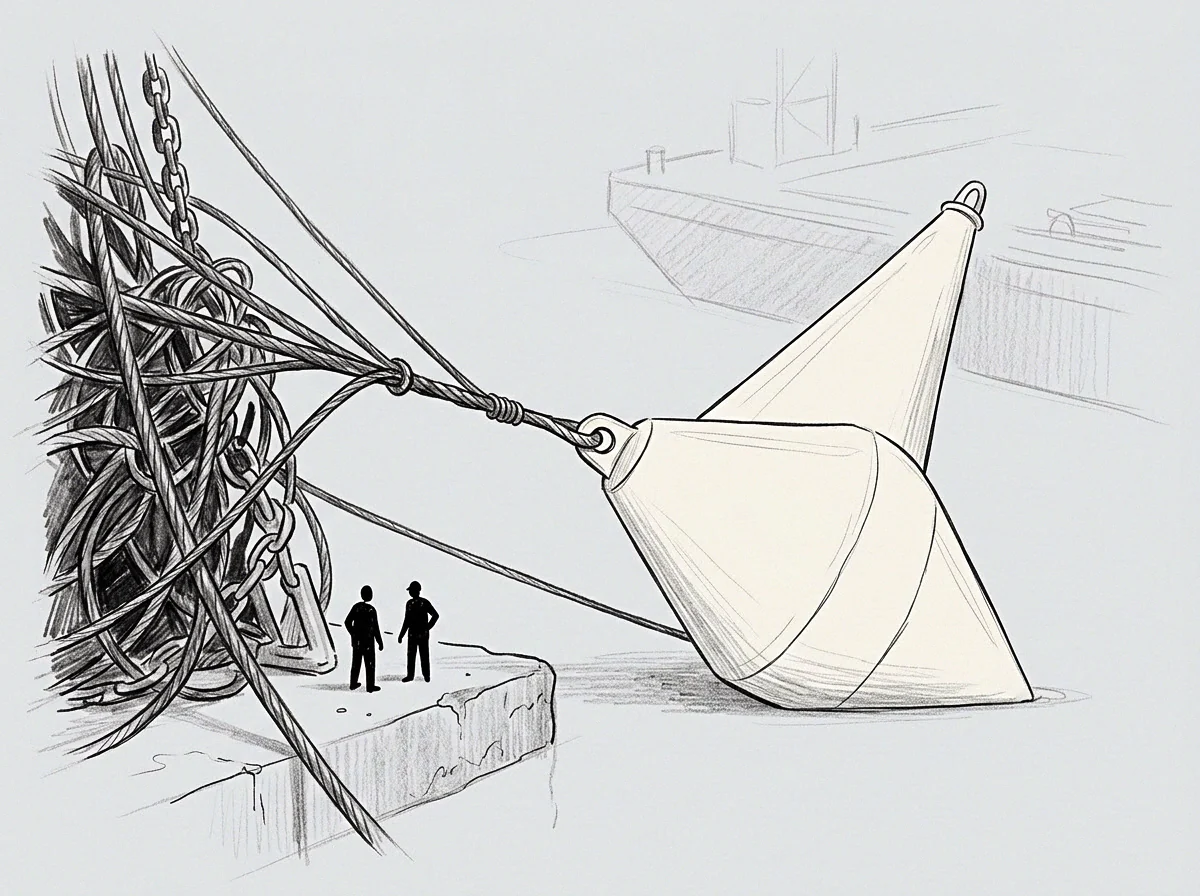
Clients return to the original partner until internal account boundaries are strictly enforced.
When an outgoing partner continues answering off-book client queries, internal authority dilutes, creating operational ambiguity that undermines successor confidence.
Client Boundary Enforcement After Transfer
When clients bypass the new lead, internal governance redirects them immediately. The original relationship owner refrains from answering substantive questions on old accounts. Several structural failure modes occur when boundaries soften during the final exit phase.
- Back-Channel Drift occurs when outgoing leads continue answering client calls off-book, undermining successor authority and confusing operational priorities.
- Scaffold Retention happens when temporary oversight mechanisms become permanent approval bottlenecks, destroying successor operational independence.
- Authority Inflation manifests when successors lack the commercial discretion needed to resolve routine account disputes, forcing repeated client escalations.
- Premature Decoupling arises when firms remove relationship oversight before verifying successor mastery over tacit client preferences, triggering churn.
Enforcing strict communication protocols forces the client to accept the successor as the primary authority. If a client attempts to re-engage the founder, the founder forwards the message to the new lead within one hour, copying the client with a brief statement of complete confidence in the successor’s authority.
Whether small professional services firms can fully separate equity valuation from founder relationship dependency without fundamental restructuring remains an open operational question.