
Contractual Mechanisms For Transferring Tacit Architectural Knowledge In Early Stage Systems
Transferring tacit architectural knowledge requires structuring legal retainers and equity holdbacks around live operational verification rather than code delivery.
Bench
The Limits of Proprietary Rights Clauses
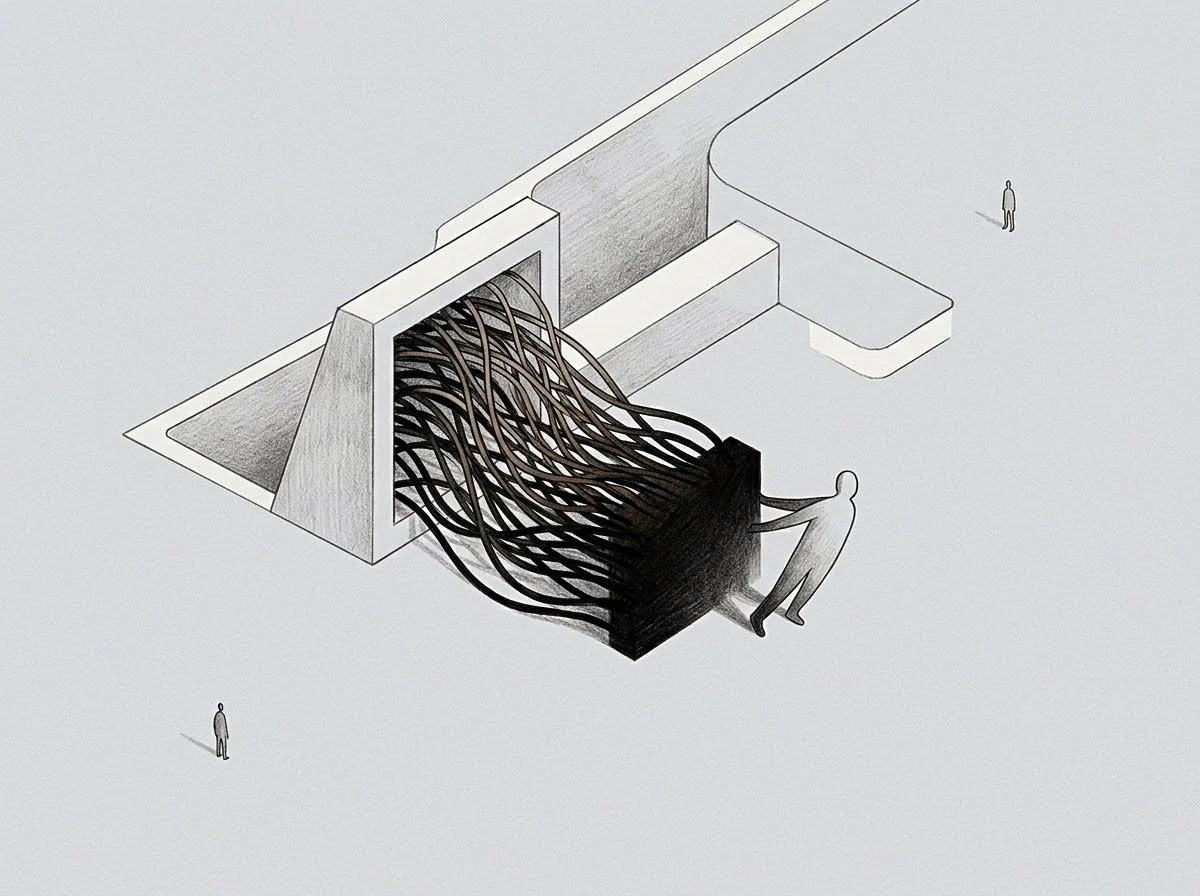
An incoming engineer sits down at an unfamiliar workstation to assume control of an early-stage codebase, facing a repository with automated tests that pass completely while production crashes every Tuesday at midnight. The failure stems from an unwritten state reset sequence executed manually by the departing builder during early deployment runs. Legal transfer omits tacit context.
Standard Intellectual Property assignment clauses transfer legal ownership of source code text, text files, and commit histories. Legal assignment leaves the dynamic operational knowledge locked inside the departing engineer’s memory. Code repositories store static instructions, whereas operational architecture includes timing dependencies, queue threshold heuristics, and recovery procedures created during crisis responses.
Software contracts traditionally treat system handovers as asset transfers. This structural assumption breaks when applied to seed-stage infrastructure where architectural trade-offs remain undocumented. The technician who designed the system carries implicit context regarding which database queries degrade under load and which microservices depend on non-standard environment variables.
System context resides in execution. Static text conceals dynamic behavior. When contract terms specify delivery as the push of a Git repository to a company account, the legal obligation finishes while the operational transfer remains incomplete.

Tacit System State and Operating Memory
The gap between repository ownership and system operational capability generates hidden risk for early-stage firms. The incoming engineering lead occupies the seat, yet lacks the mental model required to alter core data models without triggering cascading failures.
- Silent Dependency Traps: Codebase test suites greenlight builds while concealing manual initialization sequences executed only during infrastructure recovery.
- Orphaned State Drivers: Configuration parameters remain absent from setup guides, forcing new maintainers to reverse-engineer state transitions during live outages.
- Unwritten Concurrency Limits: Distributed locking assumptions rely on implicit network latency bounds that fail when node counts expand.
The repository holds code alone. When contracts measure transfer by files delivered rather than operational execution, the cost arrives as unbudgeted downtime during the first unassisted deployment.

Covenant

Structuring Architectural Transfer Covenants
Translating tacit system context into legal obligations demands a shift from static IP assignment to active co-operating covenants. A standard transition agreement binds the departing technician to respond to email queries on a best-efforts basis. Best-efforts advisory covenants produce high latent friction, because answering questions asynchronously forces the departing builder to reconstruct system context from memory without live environment feedback.
Effective contractual provisions govern the physical mechanics of knowledge transfer by specifying mandatory collaborative operations.
Architectural transfer covenants specify mandatory paired engineering hours dedicated to live operational tasks rather than passive response sessions. The contract structures these hours around active system modification, including schema migrations, service refactoring, and fault injection runs. By binding compensation to joint execution, the contract forces the implicit operational heuristics into visible execution where the incoming team can record and analyze them.
The covenant converts silent operational habits into visible collaborative procedures by attaching compensation directly to joint technical execution.

Milestone Definitions for Implicit Engineering Knowledge
Defining clear contractual milestones for undocumented systems requires moving beyond code completion metrics. Legal terms bind payout events to verifiable operational competencies developed by the incoming team. Contract drafting relies on objective triggers to verify that tacit context has transferred completely.
Milestone structures define explicit testing boundaries rather than subjective satisfaction clauses. A drafted covenant states that equity releases or advisory payouts trigger only after the successor team successfully completes a cold-start deployment without external intervention. The contract conditions financial settlement on demonstrated operational independence.

Vesting

Knowledge-Linked Equity Acceleration and Holdbacks
Equity acceleration and vesting schedules represent primary control points in early-stage founder and key-employee transitions. Traditional vesting contracts operate purely on calendar durations. Calendar vesting measures attendance alone.
A calendar vest rewards physical presence without measuring whether the departing technician transferred critical operational context to the incoming team. When a departing architect retains unvested equity subject only to time elapsed, the incentive to document hidden architectural failure modes vanishes after the departure announcement.
Contractual structures resolve this misaligned incentive by implementing knowledge-linked vesting holdbacks. A fixed percentage of unvested equity or cash severance enters an escrow holdback account, governed by specific operational transfer milestones. The contract stipulates that held equity accelerates only when the incoming engineering team completes defined system maintenance benchmarks without relying on the departing architect.
The holdback aligns financial incentives.
An equity holdback converts passive calendar presence into an enforceable financial incentive for explicit knowledge transfer.

Which Clause Secures Tacit Transfer During Founder Departures?
The reverse-vesting architectural holdback clause provides legal security during rapid technical founder transitions. This clause applies specifically when a technical co-founder exits the operator seat while retaining significant equity ownership. Standard founder equity agreements permit full vesting acceleration upon departure without cause or during structural transitions.
The reverse-vesting holdback modifies this mechanism by conditioning a dedicated equity slice upon successful technical handover completion.
The table below summarizes contractual mechanisms used to govern tacit engineering handovers, detailing explicit triggers, boundaries, and associated residual risks.
| Mechanism Name | Contractual Trigger | Knowledge Scope | Verification Method | Primary Failure Mode |
|---|---|---|---|---|
| Time-Vested Advisory Retainer | Calendar elapsed months | Ad-hoc query resolution | Self-reported hours logs | Passive response delay without knowledge absorption |
| Milestone Reverse Vesting Holdback | Independent cold-start deployment | Deployment runbooks and state recovery | Successor cold-start test run | Disputed evaluation of build completion metrics |
| Paired-Operation Covenant | Completed joint execution hours | Data pipeline schema transitions | Recorded pairing sessions | Superficial compliance without deep structural transfer |
| Shadow Operational Standby | Unassisted incident resolution | Production emergency heuristics | Zero-intervention incident resolution | Unbounded escalation requests during production outages |
When structuring these provisions, legal counsel specifies exact parameters of advisory support. The contract specifies maximum weekly commitment hours, escalation response windows, and hourly compensation rates applied to out-of-scope technical requests. Clear hourly boundaries prevent the departing technician from absorbing unpaid operational work while protecting the firm from abandonment during critical failures.
The departing builder expects full equity release upon exit, while the firm demands operational stability before settling the cap table balance.

Proof

Operational Verification Protocols
Written documentation rarely captures the full operational reality of an early-stage distributed system. System architectures evolve through rapid code iterations, leaving architecture diagrams out of sync with production code paths. Written diagrams lag production code.
Contractual mechanisms look beyond written sign-offs and implement objective verification protocols based on system performance and fault recovery.
Verification protocols operate on the principle of simulated failure. The agreement dictates that prior to final contract settlement, the system undergoes controlled fault insertion while the departing architect observes without intervening. Operational testing replaces subjective claims.
If the successor team successfully restores operational service within defined service level windows using only documented runbooks, the contractual threshold is satisfied. Operational testing converts subjective claims of complete handover into empirical evidence.

The Worked Failure Simulation Sequence
Take an early-stage startup where a departing principal infrastructure engineer holds five percent unvested equity subject to exit transfer terms. Assume the core system relies on a custom event streaming engine with undocumented failover routines known only to the departing engineer. The exit contract structures the handover across a thirty-day window using a three-stage verification protocol.
- Stage one binds the departing engineer to conduct three recorded refactoring sessions covering event queue state mechanics.
- Stage two specifies an unassisted cold-start deployment performed entirely by the incoming team on a staging environment.
- Stage three executes an unannounced staging cluster node termination to test incident recovery without departing engineer intervention.
In this worked scenario, if stage three reveals an undocumented manual database connection patch, the equity holdback remains locked. The contract grants the departing engineer ten additional business days to document the patch and repeat stage three. This structured iteration aligns the financial outcome directly with functional knowledge transfer.
Architectural verification relies on unassisted system recovery rather than written documentation approval.
Technical verification succeeds when execution replaces explanation during system recovery operations.

Seat
Separating the Technician Seat from Founder Equity
Founders frequently conflate their equity position as owners with their operational responsibilities as lead technicians. Equity ownership differs from labor. When a founder exits the lead technician seat, clarity demands separating equity governance from operational service agreements.
Owning equity grants cap table rights; occupying the technician seat entails specific daily duties, code review obligations, and operational availability hours.
Contractual mechanisms formalize this separation during early-stage transitions. A founder exiting the technician seat signs a distinct consulting advisory contract that explicitly defines operational boundaries. The contract fixes weekly hours, sets escalation response windows, and establishes an hourly rate for emergency interventions.
The technician exits the seat. This contract isolates ownership equity from ongoing operational labor, preventing the incoming engineering team from leaning indefinitely on the outgoing founder for day-to-day execution.
Conflating equity ownership with technician duties traps the departing builder in permanent unpaid operational maintenance.

Capacity Limits in Dual-Seat Retainers
Transition retainers that lack explicit capacity limits create severe role strain for both the outgoing architect and the incoming team. Unbounded support creates role strain. An outgoing architect who agrees to open-ended post-exit support without clear hourly caps quickly finds their calendar consumed by routine troubleshooting.
The incoming team delays taking true ownership of the system, relying on the outgoing builder as a permanent escalation path.
The seat carries a capacity cost. Structuring dual-seat retainers specifies hard cap boundaries: ten hours per month of baseline advisory support, with additional hours billed at premium rates. Once the baseline allocation expires, further technical requests specify explicit authorization and additional budget allocation.
This economic friction forces the incoming team to resolve issues independently, accelerating genuine tacit knowledge transfer and completing the transition out of the technician seat.
What contractual boundary prevents an incoming team from treating an advisory retainer as a permanent operational crutch after equity releases?