
Formalizing Governance Thresholds When Delegating Founder Technical Authority
Formalizing technical delegation converts unwritten founder vetoes into explicit architectural thresholds based on decision reversibility and capital exposure.
Floor
A terminal prompt blinks in an empty office at two in the morning while twenty pull requests sit untouched in an asynchronous review queue. The company creator reads line-by-line diffs of database migration scripts, checking column types and foreign key constraints between conversations with commercial partners and prospective hires. This pattern repeats nightly across early technology firms that pass twenty employees, where the author of the original software prototype continues to examine every database index mutation, queue worker configuration, and infrastructure file.
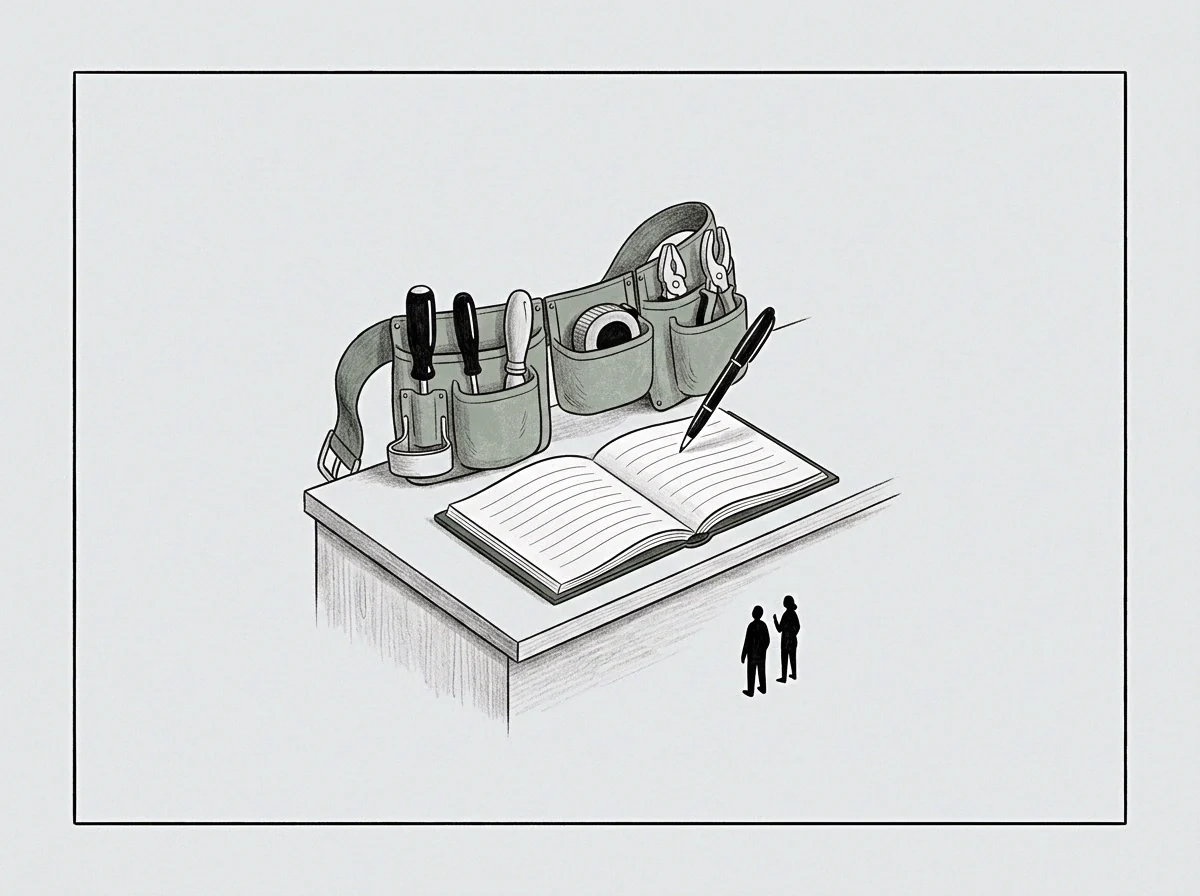
The operational drag originates in compressing three distinct structural positions into a single body. In role analysis, one individual simultaneously occupies the technician seat, the manager seat, and the founder seat. The technician seat writes code, debugs memory allocations, and tests network failovers.
The manager seat schedules sprint commitments, resolves cross-functional dependencies, and supervises engineering personnel. The founder seat allocates legal ownership, determines capital distribution, and bears enterprise survival risk. When growth requires hiring outside engineering specialists, the creator rarely steps out of the technician seat intentionally, remaining in it by habit and maintaining an unwritten veto over technical decisions across the engineering department.
A pull request sits unmerged for five days because nobody knows whether the technical lead holds the right to alter production indices.
Switching between these seats imposes heavy psychological and structural burdens. Measurements in executive cognitive switching show that moving from strategic commercial governance to low-level syntax debugging consumes substantial attentional reserves. The technician seat claims thirty hours.
When those thirty hours compete against twenty hours of executive oversight and fifteen hours of commercial operations, physical exhaustion sets in. The company architect faces role conflict, torn between the desire to prevent runtime anomalies and the executive responsibility to fund operations.
Latent Authority and Unstated Vetoes
Unwritten technical limits generate organizational paralysis. When an enterprise hires a principal engineer or an engineering vice president without explicit boundary terms, the incoming operator works under an implicit illusion of autonomy. The operator alters a microservice interface, deprecates an internal remote procedure call, or selects a third-party caching library.
Days later, the creator discovers the modification and revokes it during an evening code review, halting development with a silent veto.
The creator rationalizes this intervention through historical familiarity with edge cases from the prototype phase. The engineering staff interprets that same intervention as an unpredictable display of personal sovereignty, where authority drifts toward the louder voice. The resulting dynamic degrades engineering autonomy, encourages defensive programming, and converts senior technical hires into overpaid transcriptionists who wait for tacit approval before committing operational changes.
Unchecked centralization leaves an organization with depleted sprint throughput, an exhausted principal architect, and an engineering staff unable to commit architectural changes independently.
Tier
Decomposing technical authority into categorical boundaries removes the arbitrary nature of personal intervention. Rather than treating technical decisions as a monolithic domain governed by informal intuition, structural governance classifies architectural actions through clear blast radius assessments, financial exposure measurements, and data persistence guarantees. This approach relies on the operational reversibility of any design commitment.
Technical decisions distribute across four unambiguous operational classes:
- Data persistence modifications alter the underlying storage engine, relational schema relationships, or partition keys, producing irreversible operational dependencies that survive multiple release cycles.
- Third-party vendor commitments bind corporate capital to external software services, involving recurring infrastructure expenses and specialized network egress configurations.
- Core protocol definitions govern public interfaces, event contracts between internal domains, and client data serialization standards that external consumers rely upon.
- Interface rendering adjustments modify localized application logic, presentation layer layouts, and ephemeral caching routines that developers can revert within minutes without persistent state corruption.
Reversibility determines the decision tier. Operational friction declines when teams distinguish reversible commitments from irreversible structural locks. An interface presentation tweak carries low reversibility costs, while migrating from an asynchronous message bus to a transactional distributed log involves substantial capital expenditure and multi-month engineering reallocation.
Reversible architectural choices belong entirely to the operating team, while permanent commitments to storage engines or wire protocols remain with executive governance.
When an organization leaves the boundaries between these categories undefined, every engineering choice defaults upward to executive code review. The principal creator becomes the sole validator of mundane front-end component state shifts, consuming executive hours on operational minutiae that carry no enterprise survival consequence.

Establishing Boundaries for Operational Decisions
Separating these choices creates structural clarity between the executive suite and the engineering floor. By placing reversible modifications within the exclusive jurisdiction of the engineering team, the creator relinquishes day-to-day syntactic oversight. The engineering lead assumes responsibility for unit test coverage, local service reliability, and internal code style compliance.
The creator reserves formal authority exclusively over irreversible commitments that alter organizational burn rates, legal compliance boundaries, or structural database layouts.
When the cost of reversing a design choice exceeds the capital required to build it twice, operational autonomy yields to formal committee review.
Lever
Formal instruments transform ambiguous organizational boundaries into verifiable operational routines. The most dependable instrument for this delegation remains the Architectural Decision Record. An Architectural Decision Record documents the context, alternatives, trade-offs, and consequences of a technical choice, replacing informal hallway conversations with an auditable written artifact that prevents political friction.
Under a structured governance arrangement, thresholds for escalation operate through specific operational triggers:
- Threshold escalation protocols activate when a technical modification introduces a new persistence layer, alters public application programming interfaces, or commits the firm to third-party computing expenses exceeding five thousand dollars monthly.
- Asynchronous review periods mandate a seventy-two-hour window during which executive stakeholders can review the written proposal, request clarifications, or log formal reservations.
- Formal exception logging captures architectural overrides, recording the rationale, predicted repayment schedules for technical debt, and explicit review dates directly within the software version control repository.
By binding executive review to formal written thresholds rather than personal preference, the protocol bounds operational divergence and allows the engineering staff to move forward with predictability while the proxy architect signs the diff.
A stated limit restricting executive intervention to irreversible protocol breaks protects engineering momentum while bounding enterprise exposure.

Does Graduated Delegation Compromise System Coherence?
Practitioners frequently dispute whether graduated delegation fragments software coherence. One perspective asserts that autonomous engineering teams, unconstrained by a single technical mind, inevitably introduce conflicting design patterns, duplicate dependencies, and degrade overall system integrity. The opposing perspective contends that centralizing architectural reviews creates an artificial bottleneck that paralyzes development velocity and masks poor engineering documentation behind individual heroics.
Evidence from software development governance studies demonstrates that system coherence depends on clear interface boundaries rather than centralized control over line-by-line syntax, based on empirical analyses of mid-sized technology enterprises operating service-oriented topologies. If an enterprise operates a tightly coupled single-executable codebase where components lack domain isolation, modular boundaries do not yet exist to insulate independent development tracks. Under those monolithic conditions, the organization must introduce modular separation at the application layer before delegating technical authority across functional boundaries.
Restricting executive intervention to irreversible protocol modifications transfers full operational deployment authority to the staff engineering cohort.
Post
Examining two distinct operating models demonstrates how formal thresholds alter organizational velocity and founder workload over time. Consider two comparable technology companies, Company Alpha and Company Beta, each maintaining twenty-four engineers and forty microservices under identical commercial trajectories over an eighteen-month operating window.
Company Alpha maintains an informal governance arrangement, with the creator retaining sign-off over all technical pull requests and database alterations. Company Beta formalizes governance thresholds, using written records with explicit dollar-value spending triggers, clear data boundary categorizations, and formal review windows.
| Operational Criterion | Company Alpha (Informal Review) | Company Beta (Formal Thresholds) |
|---|---|---|
| Weekly Creator Hours in Code Review | Twenty-eight hours spent in line-by-line code reviews | Four hours spent reviewing formal decision records |
| Pull Request Cycle Latency | Six days from opening to production deployment | Fourteen hours from opening to production deployment |
| Engineering Staff Retention | Fifty-five percent annualized staff retention | Eighty-eight percent annualized staff retention |
| Emergency Database Incident Frequency | Seven production outages caused by emergency hotfixes | Two production outages caused by emergency hotfixes |
| Capital Incurred on Unused Infrastructure | Eighty-two thousand dollars in orphaned cloud instances | Nine thousand dollars in orphaned cloud instances |
Tacit review models degrade over time. In Company Alpha, the engineering staff waits constantly for executive attention as pull requests rot on branches and require repeated rebasing against moving targets. When critical production defects occur, the creator intervenes directly, applying undocumented hotfixes that bypass code review entirely and leave defects in the operational record.
In industrial civil engineering, site managers pour thousands of tons of concrete without consulting the chief structural surveyor, provided the batch satisfies certified slump tests and core pressure tolerances. The surveyor inspects the foundational pilings and structural bridge joints, leaving routine batch chemistry to verified on-site procedures. Software engineering governance requires that same separation of structural integrity checks from daily operational execution.
The engineering team can ship production builds without wondering whether their technical choices will be discarded during Sunday evening code reviews.
Helm
Stepping out of the technician seat does not mean abandoning technical governance. Instead, the individual shifts from active software builder to technical governance director, transferring the founder from execution inside the deployment pipeline to systemic risk management from the executive desk, where formal limits protect engineering velocity.
The technical governance seat evaluates capital efficiency, security posture, and structural architectural fitness. The person in this seat reviews quarterly infrastructure spending trends, ensures disaster recovery rehearsals take place, and verifies that the firm maintains compliance with regulatory frameworks. Keystrokes inside a code editor cease, replaced by structural evaluations of technical debt and team capability.
Technical authority shifts from personal intervention to structural boundary design whenever operational growth outpaces a single individual cognitive bandwidth.
This transition extracts a psychological price. Writing code provides immediate gratification: a bug is diagnosed, an automated test passes, a feature deploys. High-level corporate governance offers no such feedback loop, leaving the individual to experience a period of dislocation from the software craft that defined their initial contribution as capital allocation dictates structural priority.
What remains unresolved is how an organization recalibrates these technical governance thresholds when an unforeseen technological transition abruptly renders existing architectural boundaries obsolete.