
Mathematical Bounds On Senior Ownership Capacity Decay Under Persistent Tactical Escalation Dynamics
Senior ownership capacity decays exponentially when recurring tactical escalations create context switching fees that displace strategic governance bandwidth.

Desk
A message arrives late in the evening regarding an unstable infrastructure deployment, and the founder opens a terminal to patch the configuration directly. Context switching destroys strategic capacity. This operational intervention resolves the immediate client failure, yet it silently shifts the founder out of the ownership seat and into the technician seat.
Every senior role in a growing enterprise contains three distinct operational seats: the technician who executes production work, the manager who coordinates human systems, and the owner who governs capital allocation and structural risk. When tactical emergencies recur, the owner fills the operational gap, allowing tactical demands to eclipse long-term ownership governance.
The transition between these seats carries a heavy cognitive overhead. A founder who toggles between high-severity technical resolution and long-range capital planning pays a context-switching fee measured in hours of diminished focus. The human mind cannot instantly convert from the hyper-focused, immediate problem-solving state demanded by tactical outages to the open-ended, probability-weighted reasoning required for enterprise ownership.
Over time, persistent tactical escalation forces the senior owner to reside permanently in reactive operational seats.
Operational interruption frequency directly determines the rate at which strategic governance capacity degrades.
Operational fires always command priority. The urgency of a live operational crisis triggers acute cognitive load, capturing attention through immediate risk signals. Ownership governance, by contrast, operates on prolonged feedback loops without immediate emotional pressure.
When tactical escalation dynamics become persistent, the senior owner’s working week dissolves into a continuous series of operational disruptions, leaving zero cognitive capacity for risk modeling, governance oversight, or equity stewardship.
When an enterprise leaves this allocation unchecked, senior ownership capacity degrades into passive operational maintenance. The owner becomes a bottleneck for low-level technical decisions while structural risk accumulates across the balance sheet unnoticed.

Load
Tactical escalation dynamics follow precise queuing patterns. In an early-stage or rapidly expanding organization, operational exceptions arrive at unpredictable intervals. When junior management or technical infrastructure lacks the structural authority to contain these exceptions, the incident escalates directly to the senior owner.
The owner’s seat becomes the default catch-basin for unbounded operational noise. As arrival rates for tactical interruptions approach processing bandwidth, queue lengths increase non-linearly, consuming all residual cognitive capacity.
The nature of operational workload differs fundamentally from ownership governance across four core structural metrics. The structural friction generated when an owner remains trapped in tactical queues is outlined in the comparative breakdown below.
| Structural Metric | Tactical Technician Seat | Ownership Governance Seat | Impact of Persistent Escalation |
|---|---|---|---|
| Arrival Rate | High frequency, stochastic arrival | Low frequency, scheduled cadences | Governance schedules yield completely to tactical arrivals |
| Latency Tolerance | Zero tolerance, immediate response | High tolerance, deliberate reflection | Urgency displaces high-value reflective analysis |
| Decision Reversibility | High reversibility, localized impact | Low reversibility, systemic impact | Systemic choices are executed with tactical haste |
| Resource Drain | Acute cognitive energy, high fatigue | Sustained focus, deep synthesis | Exhaustion eliminates capacity for deep synthesis |
Tactical interrupts compound exponentially. Every operational intervention reinforces a organizational feedback loop: team members recognize that senior owners will step in to resolve complex operational halts, which reduces the team’s incentive to construct internal operational containment boundaries. Consequently, the volume of escalated incidents increases, further eroding senior capacity.
A seat defined without explicit operational bounds reverts immediately to direct firefighting.
The accumulation of tacit operational tasks creates an invisible workload. An owner managing operational exceptions performs work that rarely appears on formal organizational charts or operational dashboards. This invisible strain degrades emotional baseline energy, leaving the senior owner continuously exhausted yet unable to account for where the working week went.
The organization views the owner as an operational safeguard, while the owner experiences the seat as an unmanageable weight.
The engineering team relies on the senior owner to fix the architecture because no written term has ever restricted tactical access to that seat.
Decay
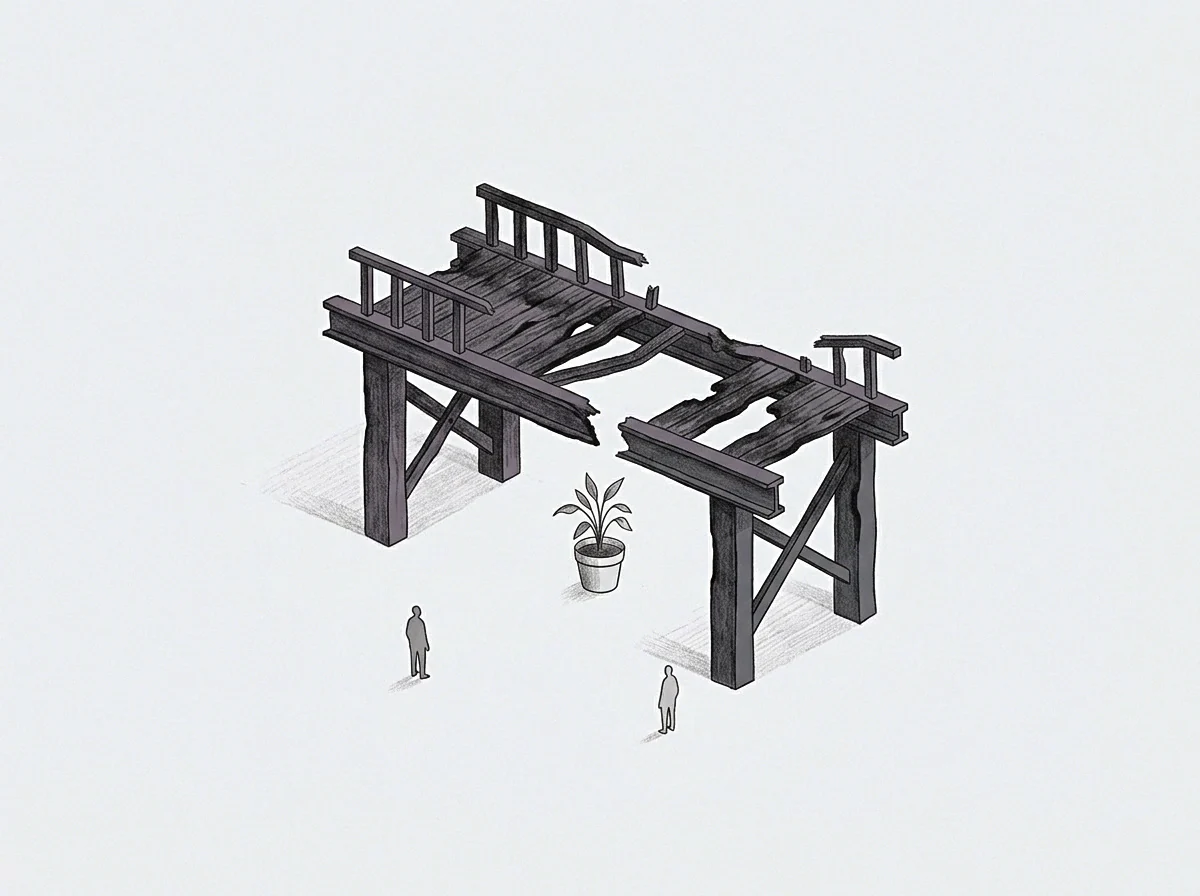
The reduction of senior ownership capacity under continuous tactical load follows a predictable mathematical decay curve. Let total cognitive capacity be bounded as a fixed quantity of usable energy hours per week. When tactical interruptions remain low, an owner allocates primary bandwidth to capital governance, partner alignment, and structural design.
As the average arrival rate of tactical incidents increases, context-switching penalties drain residual governance time faster than the linear duration of the tasks themselves.

Can senior equity oversight survive persistent operational interrupts?
Equity oversight requires undivided focus. Strategic ownership capacity decays asymptotically toward zero when tactical interruption rates cross a critical threshold. A founder receiving four operational escalations per day loses not merely four hours of execution time, but the continuous focus necessary to construct complex structural decisions.
The effective governance capacity drops to a fraction of the available hours, forcing ownership decisions into brief, fragmented windows between operational fires.
Consider a scenario where a senior owner retains forty percent equity and carries primary responsibility for investor relations and balance-sheet solvency. Assume the owner also acts as the escalation contact for client infrastructure outages. In a stable week with two operational escalations, the owner dedicates thirty-five hours to ownership governance and five hours to tactical containment.
If operational volatility rises, increasing escalations to twelve per week, the direct time spent on incidents rises to twenty-four hours. Factoring in context-switching recovery, which studies in cognitive strain estimate at twenty minutes per disruption, the time consumed by operational context reaches thirty-two hours per week. The available capacity for ownership governance drops from thirty-five hours to eight hours.
Tactical tasks always expand to consume available cognitive overhead.
The consequences of this capacity decay are structural. Strategic decisions made during fragmented, exhausted intervals carry higher error rates. The owner defers critical governance tasks, including equity structuring, senior recruitment, and financial risk mitigation, because these tasks lack the immediate urgency of operational fires.
Over extended periods, this imbalance breeds role strain, where the person in the seat feels accountable for enterprise outcomes while functionally reduced to a reactive technical troubleshooter.
What remains unknown is the precise point of irreversible exhaustion where senior ownership capacity collapses entirely, forcing an abrupt operational exit or structural failure.
Bench
Bounding senior capacity decay requires formalizing structural limits around the seats a founder occupies. A seat left unmanaged expands to consume all available personal capacity. Restoring ownership capacity demands transforming worn seats, carried through habit and reactive urgency, into held seats defined by explicit operational boundaries and explicit resource budgets.
Structural intervention begins by defining operational containment parameters. The organization must establish clear boundary conditions that govern when, how, and under what exact criteria an operational issue may escalate to the senior owner.
- Escalation Threshold Verification defines the minimum financial or operational risk level an incident must reach before senior owner intervention is permitted.
- Tactical Queue Isolation assigns direct, final operational authority to designated management roles, preventing unvetted exceptions from reaching senior oversight.
- Governance Time Reservation establishes non-interruptible blocks of strategic focused hours protected strictly from operational contact.
- Tacit Knowledge Documentation converts unwritten technical procedures stored in the founder’s head into explicit operational playbooks readable by junior operators.
Unstated limits create structural exhaustion. Delegated authority protects governance time. Implementing operational boundaries often meets internal friction, as teams accustomed to immediate founder intervention must adapt to solving complex exceptions independently.
This friction serves as an essential diagnostic signal, highlighting where management capacity is deficient and where operational training must be deepened.
Senior capacity recovers only when tactical queue ownership transfers completely to another operator.
A formal operating agreement amendment that restricts executive intervention in daily infrastructure tasks to declared corporate emergencies restores governance bandwidth immediately.
Shift
Reclaiming senior ownership capacity requires a systematic transition sequence to divest tactical operational responsibilities. Tactical noise drowns strategic signal. Ownership capacity has hard bounds.
Unmanaged queues degrade systemic focus. The shift from a reactive technician-owner to a structured equity governor requires re-architecting how operational authority is distributed across the firm.
The handover process follows a precise sequence designed to transfer tacit operational knowledge while preventing operational regression:
- Audit Operational Interventions by recording every tactical incident requiring senior owner involvement over a consecutive four-week period.
- Categorize Escalation Root Causes to identify whether intervention stemmed from missing documentation, inadequate software tools, or unclear authority bounds.
- Construct Explicit Playbooks for the top eighty percent of recurring operational disruptions, transferring resolution logic to team leads.
- Establish Firewalls Around Escalation Paths by delegating operational triage to an operator who filters incidents before executive visibility.
- Enforce Strategic Cadences by moving ownership oversight into fixed, undisturbed weekly blocks dedicated exclusively to balance sheet governance and risk management.
Tacit operational work remains invisible until recorded. Held seats mandate clear terms. When senior owners systematically remove themselves from operational queues, the organization develops internal resilience.
Team members gain operational autonomy, decision latency decreases across operational units, and the enterprise stops relying on senior exhaustion as an operational mechanism.
The senior owner who successfully completes this transition steps fully into the ownership seat. Strategic capacity stabilizes, allowing capital allocation, corporate governance, and long-term equity value creation to receive undivided cognitive focus. The operational seat remains fully staffed below, bounded by explicit terms, operating continuously without requiring the owner’s daily intervention.