
Quantifying Attentional Residue and Refractory Latency In Executive Structures
Attentional residue and refractory latency degrade strategic executive output when incompatible operating roles are cycled without structural cognitive buffers.

Drift
A founder steps out of a code review at ten in the morning to sit in a board meeting concerning a dilutive financing round. The immediate technical task remains active in working memory long after the video link closes. Experiments measuring executive control demonstrate that attention does not snap cleanly between divergent domains of responsibility.
When shifting from an incomplete or demanding primary assignment to a secondary project, a significant portion of cognitive capacity remains anchored to the initial problem. The field designates this phenomenon as attentional residue.
The carryover impairs analytical depth, pattern recognition, and decision speed. In an owner-managed structure, an executive frequently occupies three distinct positions within the span of eight hours: technician, manager, and founder. The technician writes software, sells to early clients, or debugs operational workflows.
The manager tracks delivery dates, reviews project logs, and routes resources among team members. The founder assesses capital runway, weighs strategic dilution, and establishes ownership covenants. Every crossing between these roles leaves unresolved cognitive activation.
Attention clings to an interrupted technical task long after commercial negotiations begin.
Switching tasks exacts an immediate penalty. When cognitive faculties remain anchored to technical problems, strategic discernment degrades. Research in cognitive psychology shows that task switching incurs both an immediate time delay and an elevated rate of error.
This refractory pause represents the latency required for neurocognitive networks to inhibit old rules and retrieve new behavioral schemas. Within an early-stage business, that latency appears as hesitation, shallow risk assessment, and delayed execution during management reviews.

Carryover Effects in High Velocity Roles
An operator attempting to balance multiple positions experiences an accumulation of cognitive drag throughout the working day. Attention fragments as consecutive meetings force incompatible operational perspectives into compressed intervals. The technician seat operates on low abstraction and immediate sensory feedback.
The founder seat functions under ambiguous predictive conditions with long feedback loops. Forcing the nervous system to oscillate between these operating planes several times before noon exhausts the supervisory attentional system.
- Interference Degradation occurs when semantic memories from an earlier technical assignment bleed into contract discussions, slowing comprehension and creating unforced oversights during legal reviews.
- Decisional Fatigue Acceleration manifests when the continuous reactivation of executive control depletes available attention reserves, leaving the operator prone to passive concession by late afternoon.
- Contextual Latency Compounding arises as back-to-back transitions prevent working memory buffers from clearing, resulting in persistent cognitive fog across commercial negotiations.

Where Does Residual Cognitive Activation Impair Strategy?
Commercial evaluations suffer when an executive handles personnel appraisals immediately following product escalations. The cognitive state established during a production incident is diagnostic, reactive, and defensive. Carrying that activation pattern into an appraisal session causes the executive to treat personnel inquiries as systemic defects to patch.
The persistence of cognitive load reduces the capacity to project outcomes over five-year horizons. An executive wrestling with unresolved system outages defaults to conservative, short-term solutions during product scoping sessions. The presence of residue biases assessment toward near-term relief rather than enduring structural design.
Leaving these transition penalties unmeasured results in degraded capital allocation and cumulative executive burnout.

Table
The desk measures thirty inches by sixty inches, covered in production logs, legal redlines, and unread invoices. The calendar looks uniform, yet each appointment demands an entirely different operational posture from the person sitting in the room. The technician seat claims the morning.
The manager seat consumes midday coordination. The founder seat takes the evening. The person remains the same, but the cognitive parameters required for each position contradict one another.
Quantifying the drag of these transitions requires isolating the cognitive demands of each post. The technician requires continuous immersion, where interruptions trigger an immediate loss of structural mental models that take up to half an hour to reconstruct. The manager functions across high interrupt frequency, low immersion, and rapid routing of information.
The founder operates on macro synthesis, counterfactual reasoning, and long-horizon risk appraisal. When these seats are occupied without buffers, the refractory latency between them compounds.
Executive capacity diminishes when high-immersion technical duties precede ambiguous commercial decisions.
Research in industrial psychology establishes that alternating between dissimilar task typologies generates higher switching costs than switching between related duties. Moving from drafting technical schematics to reviewing employment contracts imposes a greater cognitive reset than moving from contracts to board governance. The table below outlines the measured operational attributes, latent interference durations, and switching burdens across the three primary seats occupied within early venture structures.
| Executive Seat | Operational Horizon | Immersion Depth | Latency To Baseline | Primary Residue Trigger |
|---|---|---|---|---|
| Technician | Hours to days | High uninterrupted focus | Twenty to forty minutes | Unresolved system anomalies |
| Manager | Days to quarters | Medium fragmented focus | Ten to fifteen minutes | Unresolved interpersonal conflict |
| Founder | Quarters to years | High abstract synthesis | Forty-five to ninety minutes | Capital risk and equity covenants |
The data illustrates why an operator who writes code until eleven in the morning struggles to evaluate commercial partnerships at noon. The mental structures deployed to verify logic blocks resist immediate suppression. When the mind attempts to evaluate partnership upside while lingering on an uncommitted line of code, cognitive throughput plummets by a measurable margin.
Tacit obligations drain executive capacity. The founder assumes the work gets finished through personal discipline, while the arrangement guarantees continuous attention leakage.

Slack
Cognitive recovery requires structured gaps between operational modes. In mechanical systems, slack enables gears to engage without stripping their teeth under sudden directional changes. In administration, chronological spacing serves an identical physiological purpose.
Without deliberate latency periods between administrative appointments, the attentional system operates in a state of permanent refractory overlap.
The psychological refractory period represents the duration wherein processing of a second stimulus is delayed because the neural apparatus remains occupied with evaluating an initial event. When applied to governance duties, this latency period expands from fractions of a second to extensive blocks of daylight. The executive does not shift from negotiating commercial debt covenants to resolving customer success tickets simply because the calendar alert sounds.
Deliberate gaps between divergent administrative duties protect long-horizon discernment from technical bleed.
A founder who wears all three seats without formal boundaries internalizes the friction as personal incompetence. Role strain emerges directly from the structural contradiction of running incompatible operational positions inside identical business hours. An operator attempting to govern while maintaining operational output inevitably defaults to the position offering the most immediate tactical feedback, which is almost universally the technician seat.

Worked Schedule For A Single Operator
Consider an operator holding eighty percent equity who also serves as head of product and primary system architect. Assume fifty total hours of weekly capacity. The calendar allocates twenty hours to technical development, twenty hours to management syncs, and ten hours to governance and investor communication.
The division appears balanced on paper, but the actual sequence degrades executive functioning.
When the twenty technical hours are scattered in two-hour segments across five mornings, the switching penalty consumes fifteen percent of total cognitive throughput. The refractory latency following each programming session extends well into subsequent management blocks, leaving execution ahead of strategic evaluation. The founder spends the governance block processing residual tension from unfinished product deliverables rather than examining capital efficiency.
Structural organizational design routinely overlooks cognitive refractory duration when planning executive responsibilities.
Valve
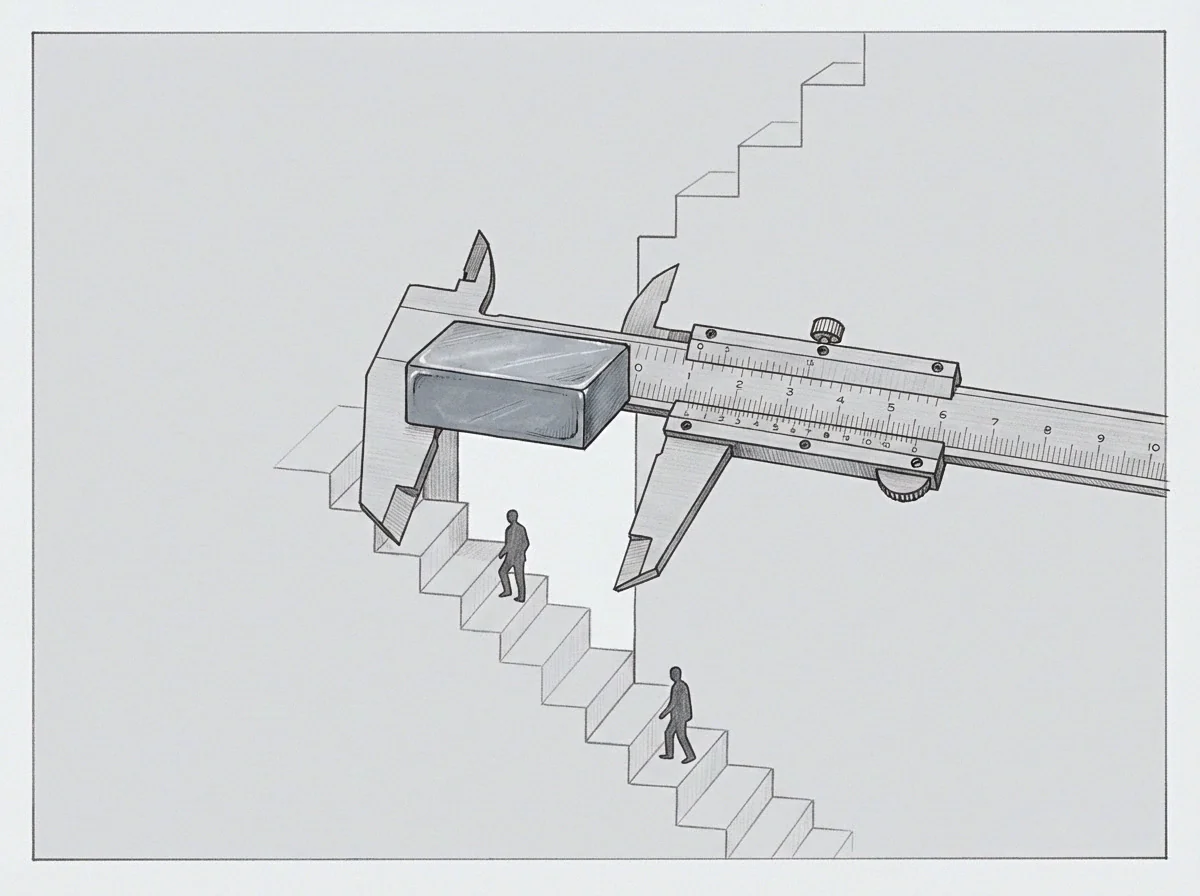
Separating executive functions demands mechanical isolation rather than internal resolve. A valve controls the direction and volume of flow through an industrial line, preventing backpressure from contaminating clean reservoirs. Executive structures require similar boundary mechanisms to isolate the technician seat from the founder seat, though standard calendars conceal that workload.
Holding a seat involves formalizing its operating terms, delineating its jurisdictional scope, and pricing its operational hours. Worn seats, by contrast, are carried unconsciously by an operator who assumes all unallocated labor belongs to their personal workload. Converting a worn seat into a held seat begins with temporal compartmentalization, assigning technical contributions dedicated whole-day allocations rather than daily morning fragments.
A seat defined by clear jurisdictional limits preserves executive bandwidth across complex corporate milestones.
Clustering management syncs into unified calendar corridors reduces attentional carryover by eliminating fragmented intervals. When the operator runs managerial tasks exclusively on designated days, the refractory recovery period occurs once per cycle rather than three times per day. The mind acclimates to a consistent operational level for the duration of the block.
Physical separation reinforces mental compartmentalization. Operating the technician role from one workstation and founder duties from another establishes situational cues that accelerate neural schema transitions. The work of governance demands sustained clarity, detached from the urgent pull of unresolved tactical tickets.
Clear jurisdictional boundaries preserve executive attention across difficult corporate transitions.