
Quantifying Enterprise Valuation Discounts From Founder Operational Dependence
Valuation discounts from founder operational dependence equal replacement management compensation plus capitalization rate premiums reflecting structural risk.

Lock
An acquirer opens the general ledger at midnight to reconcile revenue against calendar entries, discovering seventy percent of active accounts correspond to personal communications sent from one private device. The commercial contracts bear corporate letterhead, yet client renewals coincide with personal dinners, direct cellular telephone calls, and unlogged commitments made by the equity holder. Corporate revenue functions as personal trade under an incorporated banner.
The enterprise creates cash flow only while the person who founded it occupies the technician, manager, and governance chairs during the same working day.
Capital markets price an operating enterprise on its capacity to generate predictable free cash flow independent of any individual contributor. When operational knowledge, executive judgment, and client retention remain trapped within one person, a transaction purchases an unpaid employment contract masquerading as transferable enterprise value. Private equity appraisers and corporate buyers isolate this exposure through specific deduction metrics.
The valuation adjustment reflects the capital expenditure necessary to replace the uncompensated executive capacity, alongside the commercial decay that occurs when informal relationships replace contractual ties.
A transaction purchases an unpriced employment contract when operational continuity depends on one person remaining in the chair.
Earnings before interest, taxes, depreciation, and amortization present an inflated reading of economic productivity when an owner occupies multiple operating positions without taking market wages for each assignment. An owner drawing one hundred thousand dollars while functioning as executive officer, lead revenue originator, and production manager creates an artificial earnings surplus. Formal replacement of those three operational positions on prevailing market rates requires three distinct salaries, payroll taxes, and overhead allowances.
The unencumbered cash flow decreases before any market capitalization multiple applies.
Institutional acquirers categorize this exposure into distinct analytical tiers. Key person exposure addresses sudden loss of strategic direction or specialized technical output. Operational entanglement reflects the informal administrative processes residing exclusively in the founder memory.
Personal good will defines the portion of commercial trade that terminates the moment the founder separates from daily production. Capital allocators assign separate valuation haircuts to each tier to adjust for post-transaction enterprise mortality.
Take two companies generating identical net collections of two million dollars annually. The first enterprise operates through documented operating architecture, dedicated seat responsibilities, and distributed customer custody. The second enterprise relies on the primary equity holder to authorize commercial credit, oversee technical fulfillment, and resolve customer grievances.
The first business commands an enterprise valuation multiple of seven times adjusted cash flow. The second business draws offers of three times cash flow paired with deferred earnouts and substantial escrow holdbacks. The numeric variance records the price of unpriced human reliance.
The business will only be purchased if the operator stays at the desk for three years under employment terms that bind every dollar of contingent consideration to personal attendance.

Discount
Valuation appraisers quantify dependence through discount rate adjustments and normalized earnings subtractions. The capitalization rate applied to small and lower-middle enterprise transactions incorporates specific risk premiums for management depth and operational decentralization. Standard valuation protocols establish baseline capitalization metrics through build-up models.
Analysts begin with a risk-free benchmark, incorporate an equity risk premium, add an industry spread, and finish with a company-specific risk premium ranging between two and ten percent.
Heavy founder operational dependence drives the company-specific risk factor to its statutory ceiling. An increase of four hundred basis points in the discount rate reduces capitalization values immediately. Consider an asset yielding five hundred thousand dollars in stabilized normalized earnings.
Capitalized at twelve percent, the business yields an indicated value of four million one hundred sixty-six thousand dollars. Subject to a sixteen percent capitalization rate because the owner manages primary fulfillment and client retention, the indicated enterprise value falls to three million one hundred twenty-five thousand dollars. The reliance penalty extracts over one million dollars of equity value.
Valuation multiples contract in direct proportion to the volume of unwritten institutional memory held within an individual mind.
Transaction structures split the enterprise purchase price into guaranteed funds, deferred notes, and contingent consideration. The total discount materializes through structural deferral as much as outright multiple reduction. Buyers eliminate operational uncertainty by transferring down-side performance volatility back onto the seller.
When an owner operates without institutional middle management, deal contracts shift enterprise consideration toward earnout clauses contingent on multi-year retention hurdles.
The mechanic operates through direct normalization accounting:
- Replacement officer compensation deducts the exact spread between the owner historical wage and the open-market cost of professional managers hired to execute identical administrative duties.
- Customer attrition provisions reduce projected gross revenues by historical churn models observed when primary client relationships transfer from founding partners to corporate accounts.
- Administrative stabilization allowances set aside immediate balance sheet reserves to fund procedural documentation, software installations, and compliance infrastructure left undeveloped during founder tenure.
- Earnout reallocations convert unconditional cash due at transaction close into contingent tranches payable only upon verified revenue retention under replacement leadership.
Deductions compound across multiple operational categories simultaneously. An unadjusted earnings calculation of one million dollars reduces to six hundred fifty thousand dollars after booking market salaries for replacement personnel. Appraisers then apply a four-times multiple rather than a six-times multiple because customer relationships remain uncontracted.
The net proceeds realized by the owner contract by more than fifty percent relative to initial expectations.
Failing to price these operational dependencies prior to entering the market yields abandoned acquisitions, collapsed letters of intent, and punitive post-closing indemnification claims.

Audit
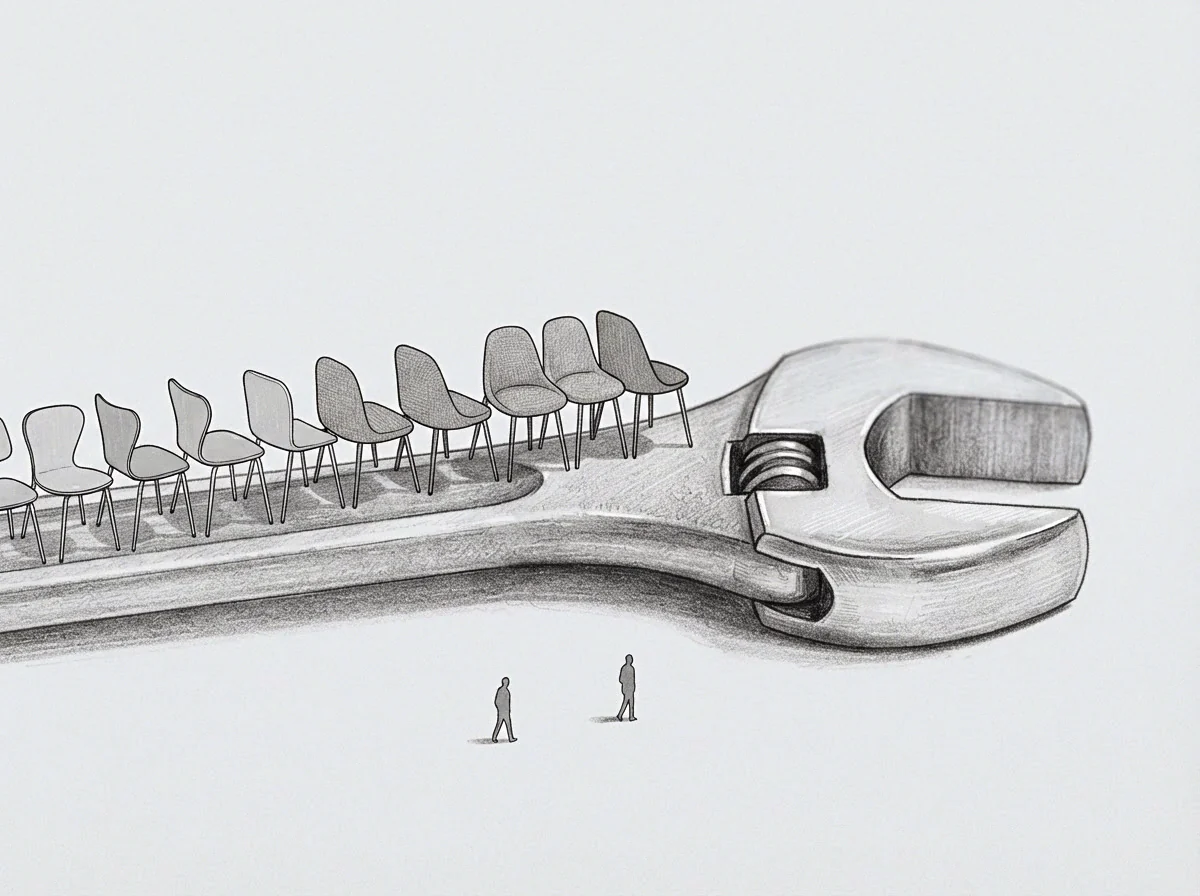
Resolving operational dependence demands granular decomposition of the executive calendar into isolated structural seats. Role strain emerges when an owner drifts between technical execution, day-to-day managerial supervision, and capital allocation without defining boundaries between those tasks. The technician seat writes code, welds steel, or services customer tickets.
The manager seat builds schedules, balances resource limits, and enforces delivery standards. The founder seat defines corporate structure, purchases assets, and bears the ultimate financial insolvency risk.
Decomposing Tacit Administrative Routines
Tacit operational knowledge functions as an invisible asset that resists transfer until translated into explicit organizational protocol. Founders routinely execute hundreds of micro-decisions weekly through experiential intuition rather than formal criteria. They evaluate credit limits for legacy clients based on personal history.
They resolve vendor shipping exceptions through direct text messages. They alter pricing matrices during verbal negotiations without recording the underlying margin thresholds. These informal practices prevent external managers from executing the seat duties with comparable precision.
The operational audit isolates these unspoken behaviors by logging all decisions requiring executive intervention over an consecutive sixty-day period. Every intervention represents an architectural absence in the firm. If a department supervisor requires founder approval to issue a five-hundred-dollar refund, the operational mechanism lacks a defined delegation boundary.
The founder remains trapped in the manager chair because the corporate policy has never been written into clear thresholds.

Where Does Personal Good Will Turn Structural?
Personal good will belongs entirely to the individual human asset, dissipating when that person leaves the enterprise premises. Structural good will belongs to the company balance sheet, surviving ownership transitions, executive turnover, and personnel reorganizations. Converting personal affinity into structural corporate value requires institutionalizing client custody, operational fulfillment, and product formulation.
Client custody transitions through account distribution. If commercial clients direct inquiries exclusively to the founder mobile number, the relationship constitutes personal good will. Introducing secondary relationship managers, formalizing ticketing channels, and binding commercial relationships through multi-year enterprise service agreements transfers relationship custody to the corporate entity.
The valuation specialist examines communication logs during due diligence to verify whether client retention survives founder absence.
Structural good will persists through ownership transitions while personal good will evaporates the day the individual departs.
Consider the physical reality of a manufacturing facility where the primary owner designs tooling setups by sight. The machine operators halt production whenever novel geometric tolerances emerge, waiting for the owner to calibrate settings. The enterprise produces high-margin specialty components, yet the valuation professional grades the entire industrial asset as a specialized machine shop vulnerable to immediate operational death.
The owner holds the technical seat while claiming the economic returns of an enterprise asset.
The central unknown remains whether an owner accustomed to direct operational command can tolerate the near-term efficiency losses that inevitably accompany delegation to less experienced administrative personnel.

Spread
Valuation discounts manifest across transactional data with measurable severity. Lower-middle market acquisitions demonstrate substantial valuation variances across firms with identical cash flow generation profiles based on executive concentration levels. The discount operates along an observable spectrum of organizational autonomy.
The variance between decentralized firms and founder-dependent businesses appears in the structural components of transacted deal value. The data reveals that operational independence increases the enterprise multiple while simultaneously lowering the percentage of transaction consideration tied to post-closing performance milestones.
| Operational Profile | Enterprise Multiple | Discount Rate Spread | Cash at Close | Earnout Horizon |
|---|---|---|---|---|
| Decentralized Management | 6.5x to 8.0x EBITDA | Base + 1.0% to 2.5% | 85% to 90% | 0 to 12 Months |
| Partial Delegation | 4.5x to 6.0x EBITDA | Base + 3.0% to 5.0% | 65% to 75% | 12 to 24 Months |
| High Operational Dependence | 3.0x to 4.0x EBITDA | Base + 5.5% to 7.5% | 40% to 50% | 24 to 36 Months |
| Sole Technician Operator | 1.5x to 2.5x SDE | Base + 8.0% to 11.0% | 20% to 30% | 36 to 48 Months |
Firms exhibiting high operational concentration suffer multiple contraction exceeding forty percent relative to peer medians. A business generating one million five hundred thousand dollars in operating profit captures ten million five hundred thousand dollars in enterprise value under decentralized governance. That identical earnings stream commands less than five million dollars when the founder dominates commercial origination and technical fulfillment.
The enterprise loses millions of equity proceeds due to the absence of mid-tier leadership.
Capital markets penalize operational concentration because cash flow predictability deteriorates under structural shock. When a key executive departs a decentralized firm, standard operating protocols and redundant personnel maintain daily shipment schedules. In a concentrated enterprise, an executive absence triggers delivery halts, customer defection, and operational paralysis.
Investors model this vulnerability by inflating discount rates and discounting future revenues.
Deal terms adjust downward to compensate for operational ambiguity. Buyers require extensive transition agreements, long-dated consulting covenants, and aggressive non-compete warranties when acquiring businesses bound to an active founder. These covenants bind the seller to the physical premises, preventing retirement or reallocation of human capital until operational systems reach full documentation.
A transition escrow clause withholding thirty percent of total purchase consideration until replacement managers complete twelve months of independent operations alters the financial yield of the entire transaction.

Covenant
Neutralizing the valuation haircut requires an operational restructuring program executed months before market engagement. The owner must systematically resign from the technician seat and the manager seat, retaining solely the governance responsibilities of the founder seat. This transition demands capital reallocation from short-term distributions toward corporate infrastructure and intermediate managerial salaries.
Building an autonomous operational tier lowers immediate net margins while expanding the eventual enterprise transaction multiple.
The process begins with procedural codification. Every repetitive operational workflow requires precise procedural manuals, decision authority matrices, and automated oversight tools. When inventory purchasing limits, client pricing rules, and quality control checks operate under objective rules, intermediate supervisors execute tasks without executive consultation.
The business transitions from human-dependent craft toward an institutional system.
Distributed client relationships remove customer concentration vulnerability. The owner introduces operational directors, service supervisors, and technical personnel into primary client interactions. Contracts must be executed under standard corporate master service agreements rather than personalized arrangements.
When renewals occur through formal department channels, the enterprise captures structural commercial equity that commands premium valuation multiples.
A business that runs smoothly during a ninety-day executive absence commands the highest valuation multiple available in its sector.