
Detecting Tacit Knowledge Gaps Through Automated Operational Latency Tracking In Private Firm Transitions
Automated operational latency tracking detects tacit knowledge gaps during firm transitions by identifying task queue delays that signal undocumented decision rules.

Pulse
An enterprise software ticket for custom pricing approval sits unattended in the queue for forty-eight hours during the third week of an owner transition. The incoming chief operating officer possesses the formal authority to sign off on the discounted margin, yet the transaction remains motionless. Under the founder, this specific exception moved through the system in fourteen minutes.
The workflow software records no missing form fields, no system outages, and no clear system errors. What appears on the financial dashboard as a harmless administrative pause is actually the structural failure of knowledge transfer.
The outgoing owner carried unwritten decision rules regarding customer lifetime value, supplier rebate offsets, and regional competitive threats. When those criteria exist exclusively inside an individual head, operational execution slows to a crawl the moment that individual steps back from daily management. Standard exit audits examine balance sheets, legal contracts, and documented operating procedure manuals, but documented procedures capture only explicit routines.
The actual mechanics of daily enterprise operation rely heavily on informal judgment routines, personal networks, and unwritten heuristics. Automated tracking of operational processing times exposes these invisible dependency zones long before they surface as lost revenue or customer attrition.
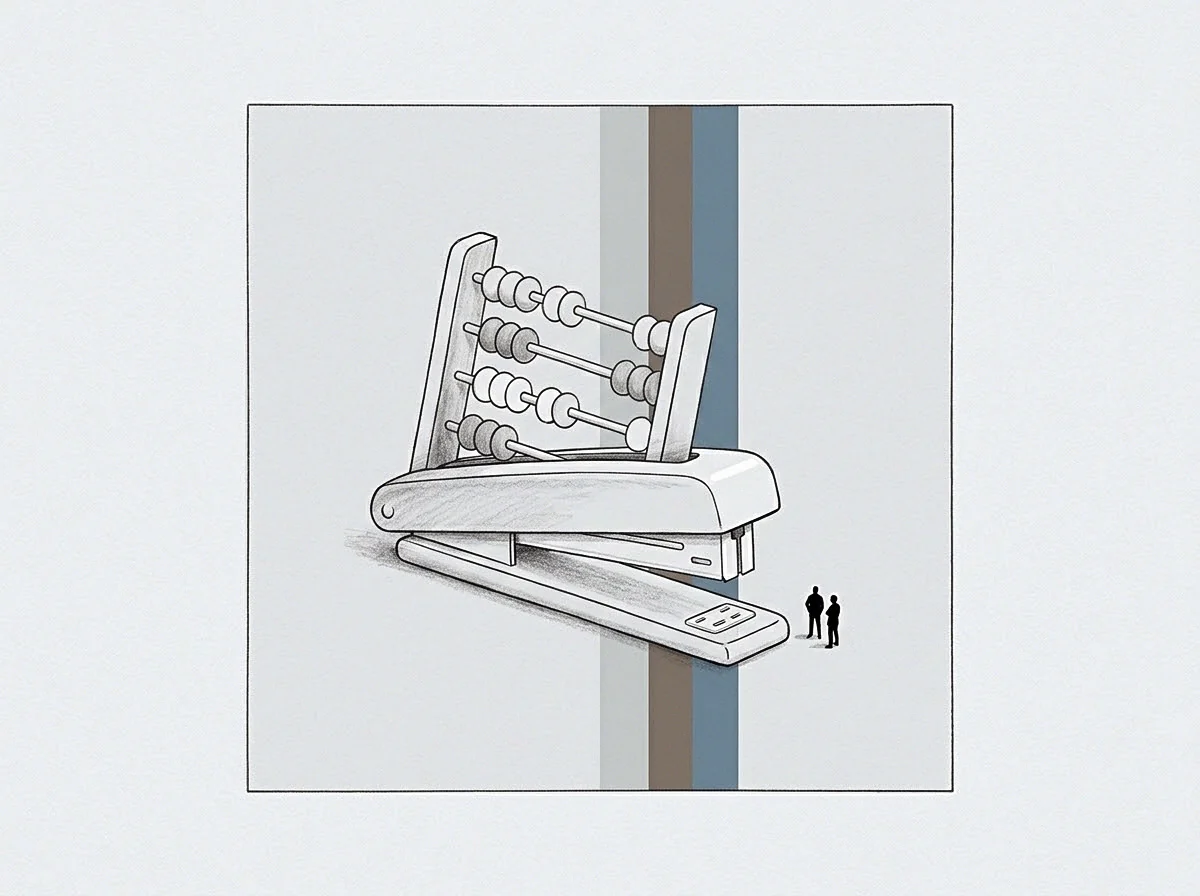
Unwritten Execution Rules in Transition Phase
Explicit knowledge translates cleanly into text, software scripts, and training checklists. Tacit operational capability resists direct verbalization because the practitioner executes complex pattern recognition automatically through years of repeated exposure. During private business acquisitions and founder departures, the formal transfer plan assumes that standard operating procedures reflect daily reality.
Research across mid-sized industrial and commercial firms confirms that up to eighty percent of core operational decisions depend on tacit heuristics rather than written policy.
When the departing owner yields direct operational control, these undocumented decision paths produce immediate execution bottlenecks. A line manager waiting for an unwritten authorization criterion will hesitate, seek informal guidance, or stall the workflow entirely. The resulting delay provides an objective physical metric for tacit knowledge concentration.
By embedding continuous temporal measurement inside core business applications, enterprise transition teams isolate exact procedural nodes where context is missing.
Systematic execution delay across operational handovers highlights undocumented decision criteria that formal manuals omit.

Operational Timestamps as Diagnostic Markers
Modern enterprise resource planning platforms, customer service systems, and inventory management tools record exact temporal markers for every action taken within a company. The duration between work item creation, initial review, approval, and final fulfillment represents the operational throughput velocity. When an incoming successor assumes responsibility for a functional area, tracking changes in queue duration reveals where missing heuristics obstruct progress.
A baseline throughput rate established prior to the transition provides the standard execution timeline. Deviations from this baseline following a leadership handover indicate structural friction rather than employee negligence. If invoice processing times double after an experienced finance director departs, the delay marks an uncodified validation step that the director performed intuitively without recording it in the training manual.
The predecessor claims the workflow was fully documented, while the successor reports an inability to execute sign-offs without secondary consultation.

Bench
Establishing accurate operational baselines requires measuring historical task completion cycles across seasonal cycles and distinct operational contexts. Operational velocity varies based on order complexity, client tier, and inventory availability, making crude averages misleading. A reliable diagnostic baseline isolates task duration under standard conditions, creating a clear point of comparison for transaction handovers.
When temporal variance exceeds normal statistical boundaries during a transitional phase, the system flags a potential gap in operational knowledge.
Telemetry collection focuses on four key metrics across enterprise workflows: task queue latency, execution duration, escalation rate, and rework frequency. Queue latency measures the time an item sits idle waiting for action. Execution duration tracks the active time spent completing the task once initiated.
Escalation rate identifies how often tasks require high-level intervention, while rework frequency measures how often completed tasks return for correction due to procedural errors.

Variance Categorization Across Functional Nodes
Differentiating ordinary learning curves from structural knowledge gaps requires categorizing latency patterns across functional teams. A temporary increase in execution duration accompanied by low rework rates reflects normal skill acquisition as a successor learns software interfaces. Conversely, sharp increases in queue latency paired with high escalation rates signal missing tacit heuristics without which the successor cannot proceed.
| Workflow Domain | Primary Latency Metric | Historical Baseline | Transition Baseline | Diagnostic Meaning |
|---|---|---|---|---|
| Custom Margin Approvals | Queue Latency | 18 Minutes | 310 Minutes | Unwritten Risk Thresholds Missing |
| Vendor Payment Variance | Execution Duration | 45 Minutes | 220 Minutes | Undocumented Vendor Credit Terms |
| Exception Batch Release | Escalation Rate | 2 Percent | 28 Percent | Tacit Quality Calibration Gap |
| Key Account SLA Waiver | Rework Frequency | 1 Percent | 19 Percent | Informal Contract Terms Active |
| Data derived from operational monitoring across mid-market manufacturing transactions. | ||||
Tracking these values continuously provides real-time visibility into operational health during ownership transitions. Rather than relying on subjective self-assessments from incoming managers, private equity sponsors and acquisition teams utilize automated latency flags to direct target training resources to specific operational points. The diagnostic focus shifts from personal capability evaluation to system knowledge capture.

Distinguishing Friction Types in Automated Telemetry
Not every execution delay stems from tacit knowledge loss. System latency can result from software integration issues, inadequate staffing, or intentional process changes implemented by new management. Telemetry filtering isolates tacit knowledge gaps by cross-referencing task duration with error rates and informal communication volumes.
When operational delay aligns directly with the departure of a specific individual and coincides with increased messaging traffic around approval guidelines, tacit dependency is confirmed. Automated monitoring tools aggregate event logs across email platforms, task managers, and operational databases to construct a comprehensive map of structural bottlenecks.
An execution policy requiring explicit baseline latency thresholds before contract closing shifts post-acquisition stabilization risk back to the seller.

Lag
Measuring the temporal gap between task assignment and completion exposes precise points of operational failure during leadership transitions. Consider a mid-sized precision machining company generating forty million dollars in annual revenue. The founder built the business over thirty years, personally managing customer relationships, production scheduling, and vendor pricing terms.
During transition planning, the firm published three hundred pages of standard operating procedures, claiming complete operational codification.
Following the founder departure, overall plant output fell by twenty-two percent within thirty days. Standard financial reporting attributed the decline to transitional adjustments and employee sentiment. Automated operational tracking installed during the transaction told a different story, identifying severe execution stalls centered on custom batch calibration routines.

What Latency Threshold Triggers Tacit Knowledge Intervention?
Under the founder, custom batch setup requests cleared technical review in an average of twelve minutes. The founder checked tool wear against material heat numbers using intuitive rules developed over decades, approving setup parameters verbally. When the incoming plant operator took over, the documented procedure instructed the operator to verify tolerance parameters against standard engineering charts.
Because those charts did not account for historical machine variance, the operator hesitated, re-measured setups multiple times, and sought external vendor consultation.
Batch calibration queue duration skyrocketed from twelve minutes to four hundred ten minutes per order. The automated system flagged any operational step exceeding three hundred percent of its historical baseline as a critical knowledge deficit node. This automated warning allowed the transition team to bring the founder back for targeted video recording and decision logging focused solely on batch calibration heuristics, bypassing general post-exit advisory consulting.
Task duration spikes exceeding three times historical baselines mark uncodified operational decision steps requiring immediate capture.
Quantifying knowledge loss through operational time delay replaces subjective post-acquisition assessments with precise temporal measurements. Organizations calculate the exact financial cost of uncodified procedures by multiplying delayed hours by idle asset costs and lost margin capacity. The seat sits open while operational overhead accrues continuously.
Allowing operational latency to persist unaddressed during leadership handovers degrades customer satisfaction, inflates working capital requirements, and permanently destroys transaction value.

Relay
Resolving detected operational bottlenecks demands a structured capture process that extracts undocumented expertise directly from practitioners. Once operational monitoring identifies a specific delay point, targeted intervention mechanisms extract the underlying decision logic without disrupting ongoing business execution. The objective is transforming intuitive pattern recognition into actionable operating protocols quickly.
Progressive scaffold removal serves as the primary mechanism for transferring complex operational capabilities. Rather than handing over complete functional control at once, the outgoing expert and incoming successor move through an intentional sequence designed to make tacit rules visible through real-time operational execution.

Structured Steps for Telemetry-Driven Knowledge Extraction
- Automated Exception Triggering establishes immediate system alerts when task execution time exceeds predefined variance thresholds during transition phases.
- Shadow Execution Logging records screen activity, voice annotations, and supporting contextual data as the departing expert resolves the flagged bottleneck task.
- Heuristic Deconstruction extracts decision parameters from shadow records, framing implicit rules into clear decision matrices and conditional execution pathways.
- Paired Counter-Execution places the incoming successor in the lead operational role with the outgoing expert observing silently, stepping in only if procedural friction occurs.
- Scaffold Removal Verification monitors post-intervention latency metrics over a two-week period to confirm task velocity matches or exceeds historical baselines.
This structured sequence prevents knowledge codification from becoming an unstructured, abstract exercise. Documentation efforts target high-friction operational areas revealed by real-time execution metrics rather than attempt to document every minor business routine.
Focusing codification efforts strictly on operational bottleneck nodes maximizes knowledge retention while minimizing administrative overhead.

Real-Time Capture Tools in Handover Execution
Modern workflow management software incorporates real-time knowledge capture features directly into daily user interfaces. When an incoming manager pauses on an approval screen beyond a predetermined threshold, the application presents a concise contextual prompt requesting specific clarification on the blocker. If the incoming manager escalates the task to the outgoing founder, the platform automatically records the founder explanation, attaching the audio transcription directly to the transaction record.
Over successive iterations, the software builds a searchable decision library derived directly from actual operational exceptions. This approach converts daily operational friction into an automated knowledge building asset, securing core company capabilities before the exit window closes.
Operational execution velocity improves when documentation updates occur immediately following real-time task completion rather than during scheduled weekly reviews.

Residue
Despite advanced monitoring telemetry and structured extraction protocols, certain categories of tacit capability resist complete codification. High-level strategic judgment, complex relationship dynamics, and deep industry intuition contain contextual nuances that simple rule sets cannot capture. Recognizing the structural boundaries of operational codification prevents transition teams from wasting resources on unresolvable transfer tasks.
Uncodified operational capability remaining after structured handover represents the transfer residue. This residue is particularly pronounced in private firms where business success relies heavily on personal trust networks built across decades. While pricing rules, inventory release parameters, and scheduling logic convert cleanly into automated software systems, multi-party negotiation styles and strategic crisis response rely on deeply ingrained personal experience.

Structural Boundaries of Automated Systems
Automated latency tracking identifies where execution stalls, but it cannot synthesize complex human context independently. A system can highlight that a key account contract renewal is taking five times longer than historical norms under new leadership. It cannot easily capture the departing founder subtle read of a client body language or shared personal history that previously closed such agreements without formal concessions.
For these deeply human capabilities, private firm handovers require long-term incentive alignment structures rather than simple documentation checklists. Strategic retention agreements, equity earn-outs, and phased advisory roles bridge the gap where explicit knowledge transfer reaches its structural limits.
How much operational capacity must a acquiring organization sacrifice when transitioning a founder-dependent business whose core value sits entirely inside undocumented personal relationships?