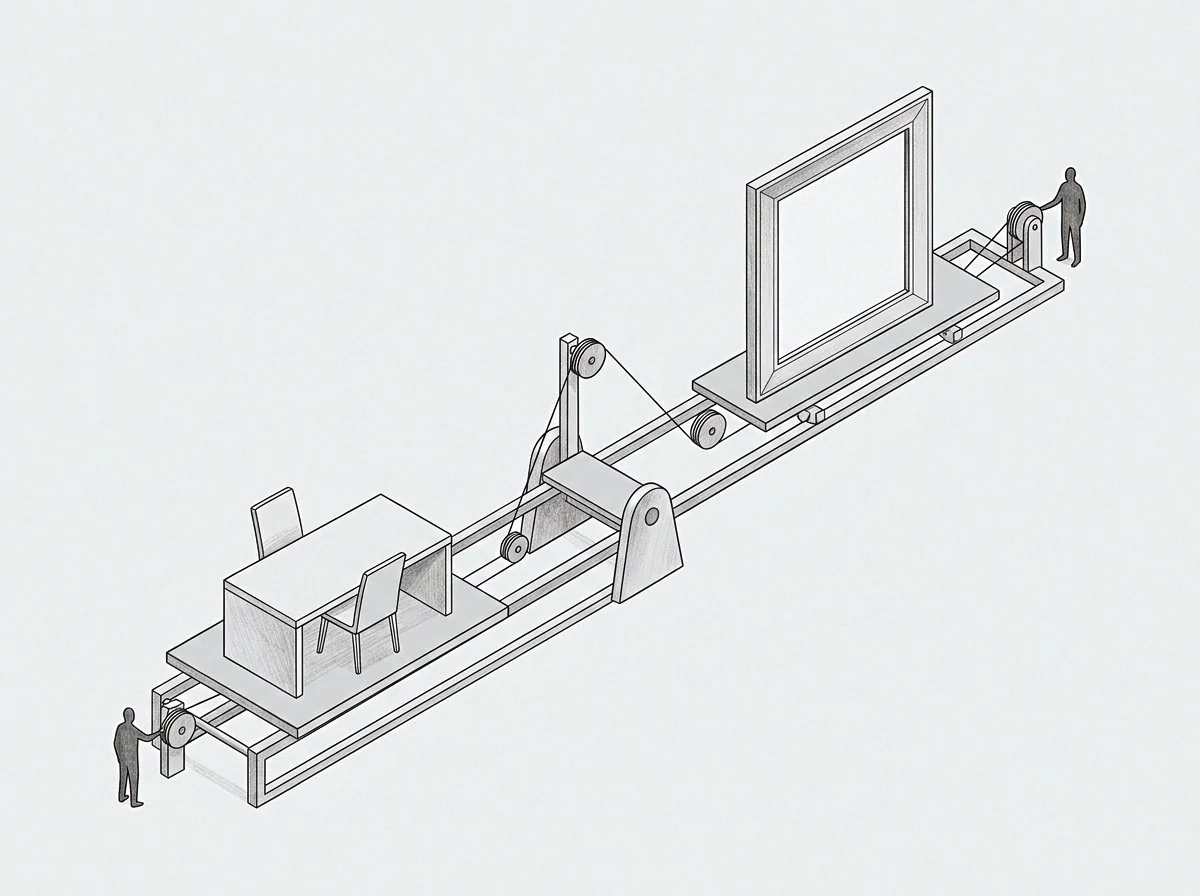
Technician, manager, founder. Three seats, one person, and the work of each read as the work of the others. A seat is worn or it is held, and the difference decides what the person in it can put down.
Executive seats require redundant operational labor buffers when transaction surges cost more in lost strategic output than carrying excess baseline payroll.
Contractual mechanisms enforce delegated executive jurisdictions under majority owners through negative covenants, voting proxies, and accelerated put options.
Middle market capital governance separates operational management wages from equity dividends through formal operating contracts and structured voting classes.
Delegated governance during founder succession transfers execution authority to incoming leads while establishing structural thresholds for residual board oversight.
Context switching between tactical execution and strategic governance forces working memory reloads, creating attention residue that degrades executive capacity.
Separating technical production from executive management replaces unpriced tacit labor with explicit governance terms, protecting executive capacity and structural solvency.
Revenue team performance degrades during volatility when unmanaged scope expansion causes high-cost acquisition roles to absorb post-sale support tasks.
Enterprise sales handovers preserve executive attention by gating post-close escalations and transferring operational authority to account teams within ninety days.
Uncoupling operational executive control from equity governance requires revoking officer signing authority while restructuring share voting rights via proxy conversion agreements.
Contractual triggers automate executive seat unbundling during expansion by binding specific performance metrics to mandatory operational role transfers.
Minority capital blocks replacement operators through supermajority vetoes, forcing operational restructuring or equity buyouts to restore executive succession authority.
Drafting shareholder agreements to handle inactive equity separates voting control from economic upside through non-voting stock and automatic conversion rules.
Unilateral seat handovers trigger equity disputes when passive owners retain profits, resolved by offsetting market labor fees against capital distribution pools.
Operational position charters decouple executive identity from company functions by explicitly codifying decision rights, metrics, and handover criteria.
Separating technical work from management in small firms requires partitioning production craft from supervisory oversight into distinct calendar blocks and explicit roles.
Forced equity redemptions execute through operating agreement protocols that convert ownership shares into deferred debt using formulaic or appraised valuations.
Successor operators resolve retained equity disputes by executing formal stock redemptions or profits interests that decouple historical equity from governance.
Enforcing LLC operating agreements during equity conflicts requires applying written vesting, dilution, and dissociation clauses to separate ownership from work.
Delegation schedules in small business purchase agreements define functional phase gates, step-down hours, and decision rights for post-closing operational transfer.
Extracting tacit operational habits into codified procedures converts personal executive labor into institutional enterprise equity before selling shares.
Contractual allocation of operational friction assigns post-transfer revenue shortfalls between buyer and seller using holdback escrows and indemnities.
Codifying tacit operational workflows into explicit seat definitions eliminates key person dependency discounts during small business equity transactions.
Decoupling technical founders from execution deficits requires formal operational partitioning, production access revocation, and intermediate technical leadership.
Six fields, each writing its own terms
The terms are written where they belong. Each field holds three desks, and every entry a desk writes raises the terms it uses, each term given a meaning, a mechanism and the places it appears. The record on these pages stays first person and hand made; the fields grow the nomenclature.