

Structural Boundaries for Technical Leaders Leaving Production Code Tasks
Technical leaders leave production coding by establishing explicit architectural governance thresholds and revoking daily repository write permissions.
Technical leaders leave production coding by establishing explicit architectural governance thresholds and revoking daily repository write permissions.

Stepping away transfers daily codebase modification to employed staff while fixing the original author into governance, architectural audit, and stated capital terms.

Growth experimentation platforms isolate causal inference from feature switches using deterministic hashing, unified telemetry, and statistical validation.

Departing owner buybacks use adjusted EBITDA baselines, subordinated seller notes, and cash-flow deferral caps to protect operating cash while repurchasing equity.

Automatic reversion triggers forfeit unvested non-voting founder stock upon operational departure, preventing passive equity from absorbing corporate liquidation payouts.

Good leaver clauses enforce conditional equity repurchase options, reclaiming departing partner shares at either fair market value or par cost.

Modifying early-stage equity vesting before resignation substitutes default buybacks with structured advisory terms, partial acceleration, or milestone releases.

Engineering throughput limits protect technical capacity from executive overcommitment by establishing binding allocations and formal signature authority over intake.

Partitioning technical governance, people management, and code architecture into distinct seats stops task switching from consuming executive cognitive capacity.

Architectural dependencies convert headcount growth into coordination drag, reducing parallel software delivery velocity unless teams govern domain boundaries with isolated contracts.

Allocating fixed engineering capacity to architectural maintenance preserves long-term feature delivery speed by preventing systemic software degradation.

Executive engineering risk boundaries decouple business solvency from technical failure through codified operational limits and automated capacity reserves.

Resolving architecture-governance asymmetry requires instrumenting continuous technical debt telemetry directly into board audit risk charters.

Executive visibility in engineering depends on structural reporting lines that route unmediated technical telemetry directly to leadership seats.

Formulaic equity valuation clauses link deferred buyout prices to current profits, causing governance gridlock when outgoing owners exercise veto powers to protect immediate payouts.

Dynamic equity recalibration clauses convert uncompensated tacit execution hours into equity credits by defining shadow wages that offset milestone forfeiture.

Operational switching costs in equal partnerships equal market wage disparities plus velocity impairment losses and diverted onboarding capacity during seat handovers.

Early stage technical performance depends on isolating deep development blocks from operational management, preventing context switching from eroding platform architecture.

Decoupling governance oversight from founder technical work requires revoking direct system access and replacing informal presence with formal board reporting.

Executive role strain during scale transitions resolves by formalizing technical debt as a capital expense and decomposing the founder position into held seats.

Accelerating delivery backlogs pull executives back into technician triage, draining strategic governance and generating structural friction across partners.

Transitioning tacit execution seats requires explicit service contracts and reverse vesting provisions that separate operational duties from equity ownership rights.

Role strain in multi-position operators arises from continuous unbudgeted context switches between execution, integration, and governance seats.

Early executive time splits divide individual production, team coordination, and corporate governance into distinct quotas to prevent operational collapse.

Governance block recovery periods scale nonlinearly with operational interference signals, demanding scheduled quarantine buffers to clear cognitive residue.

Operational interruptions transfer into executive allocations when unmediated alerts and missing delegation thresholds divert strategic hours into triage.

Executive capacity degrades when unscheduled operational interruptions exceed two events per four-hour window, requiring formal escalation filters.

Corporate statutory duties circumscribe operational autonomy by subordinating shop floor discretion to procedural checks and fiduciary oversight obligations.
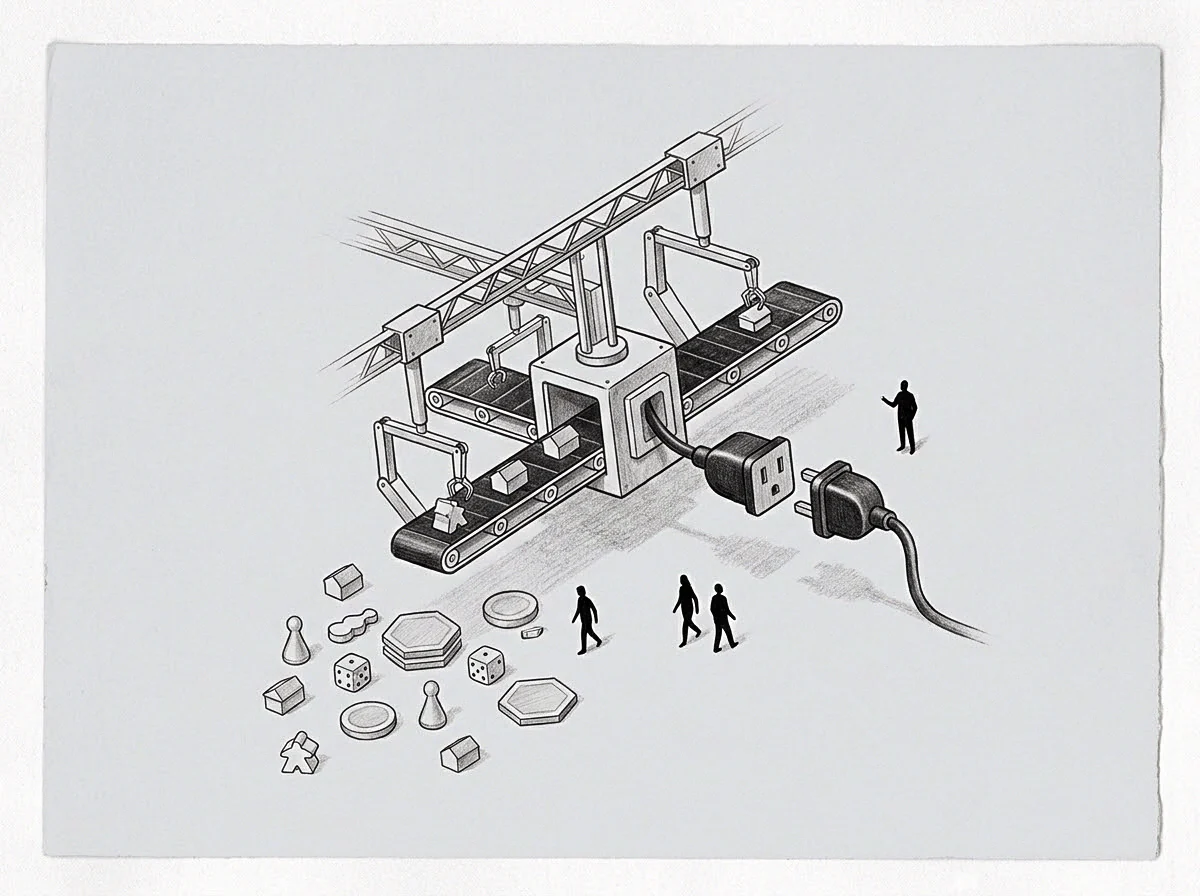
Rapid alternation between tactical execution and capital allocation causes attentional residue that consumes up to twenty percent of daily productive capacity.

Calendar block allocation partitions executive working time into discrete, defended durations that isolate technical execution from strategic governance.
The terms are written where they belong. Each field holds three desks, and every entry a desk writes raises the terms it uses, each term given a meaning, a mechanism and the places it appears. The record on these pages stays first person and hand made; the fields grow the nomenclature.